
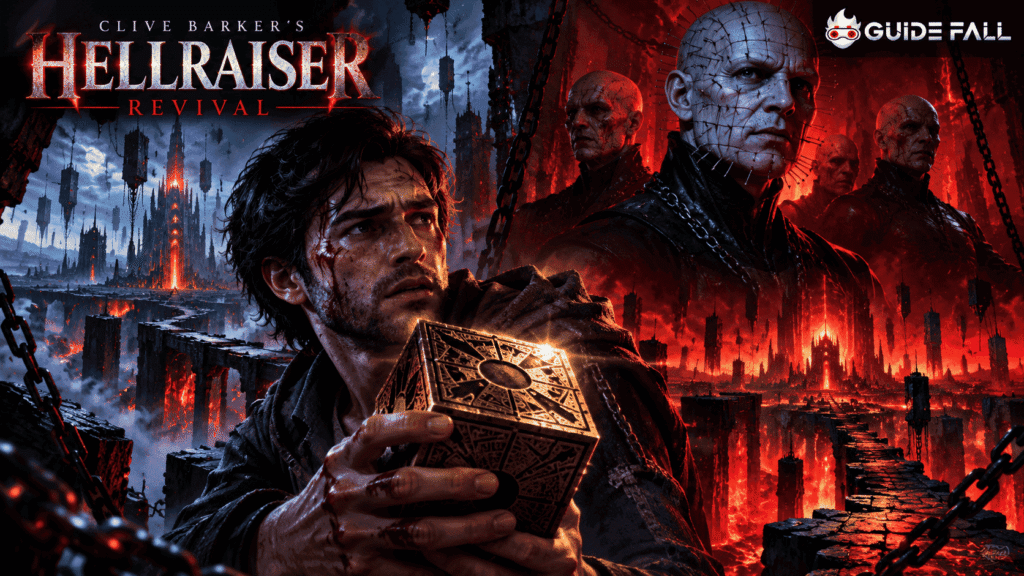

The box is also connected to the Labyrinth, a nightmarish realm closely tied to the Cenobites.
That creates an uncomfortable situation for Aidan. The very thing keeping him alive may also be connected to the danger he’s trying to escape.
Genesis Configuration: A Puzzle Box with Dangerous Powers
Puzzle boxes have always played an important role in the Hellraiser universe.
They’re not ordinary objects designed to entertain curious minds. Instead, they serve as connections to supernatural forces that humans barely understand.
The Genesis Configuration continues that tradition in Hellraiser: Revival.
Through the box, Aidan gains access to supernatural abilities that can help him survive encounters with dangerous enemies.
These powers give players more options during combat, especially when ordinary weapons might not be enough.
However, the box also raises an interesting question.
If its power comes from the same terrifying world Aidan is fighting against, how safe is it to rely on that power?
This makes the Genesis Configuration more than just another piece of equipment.
It’s closely tied to Aidan’s struggle.
He needs its abilities to survive, even though those abilities come from something potentially dangerous.
That idea fits naturally into the world of Hellraiser, where human curiosity and desire often lead to consequences nobody fully understands until it’s too late.
The puzzle box might offer Aidan a fighting chance, but that doesn’t necessarily mean using it comes without a price.
The Labyrinth: A Place No Human Should Enter
The Labyrinth is one of the most unsettling locations in the Hellraiser universe.
It’s more than a dark environment filled with monsters. The realm is closely connected to the Cenobites and the suffering that defines much of Hellraiser’s horror.
For Aidan, the Labyrinth becomes an important part of his attempt to rescue Sunny.
But entering an unfamiliar place brings dangers of its own.
Not every threat needs to be standing directly in front of the player.
Strange surroundings, supernatural forces, and the uncertainty of what lies ahead can make exploration uncomfortable long before an enemy appears.
That’s where a setting like the Labyrinth has real potential.
An empty corridor can be unsettling. So can an unusual sound coming from another room or a brief movement somewhere in the distance.
Sometimes, the possibility of encountering something horrible is more frightening than the encounter itself.
This approach works particularly well in survival horror.
Players don’t always need a monster chasing them to feel threatened. Simply knowing that something dangerous might be nearby can be enough to keep them on edge.
If Hellraiser: Revival makes good use of that uncertainty, the Labyrinth could become one of its most memorable features.
Pinhead and the Cenobites Aren’t Ordinary Enemies
Most horror games feature enemies with fairly straightforward intentions.
They spot the player, give chase, and attack.
The Cenobites are different.
In the Hellraiser universe, these beings are associated with extreme experiences that blur the boundaries between pleasure and pain.
Suffering isn’t simply something they inflict on their victims. It’s deeply connected to how they understand human existence.
Pinhead remains the most recognisable figure among them.
What makes him disturbing isn’t just his appearance or physical power. It’s the way he represents a kind of horror that goes beyond ordinary violence.
In Hellraiser: Revival, Aidan becomes involved in Pinhead’s ritual, placing him in an increasingly dangerous situation.
His problems aren’t limited to finding Sunny.
He must also deal with the consequences of becoming involved with supernatural forces he doesn’t fully understand.
The Cenobites aren’t the only enemies standing in his way, either.
Players will also encounter cultists devoted to these terrifying beings.
Their presence adds another layer to the threat.
After all, not every dangerous character in a horror story needs supernatural abilities. Ordinary people can be just as frightening when their beliefs or desires push them towards extreme behaviour.
Surviving with Weapons and Supernatural Abilities
One of the more interesting aspects of Clive Barker’s Hellraiser: Revival is its approach to combat.
Unlike horror games that focus almost entirely on hiding or escaping, Hellraiser: Revival allows players to fight back.
The game combines first-person action with survival horror elements, giving Aidan access to conventional weapons alongside supernatural powers from the Genesis Configuration.
This opens up different ways to approach dangerous encounters.
Regular weapons offer a more direct way to deal with enemies, while supernatural abilities provide options beyond ordinary human equipment.
On paper, that sounds like a promising combination.
But there’s also a potential problem.
Giving players powerful abilities can make a horror game less frightening if those abilities become too effective.
When enemies are easy to defeat, they gradually stop feeling like threats.
That’s why the balance between combat and horror will be important for Hellraiser: Revival.
Will enemies remain dangerous even when Aidan has supernatural powers at his disposal?
Will players need to think carefully about how they use their weapons and abilities, or will attacking everything in sight be enough?
Those details could make a significant difference to the overall experience.
Brutal combat certainly belongs in the Hellraiser universe, but violence alone doesn’t guarantee good horror.
The game still needs to make players feel vulnerable, even when they’re capable of fighting back.
Aidan’s Journey Is About More Than Saving Sunny
At first glance, the story of Hellraiser: Revival has a simple objective.
Aidan wants to save Sunny.
It’s a personal goal that gives him a clear reason to face terrifying enemies and venture into a world connected to the Cenobites.
But a straightforward objective doesn’t always lead to a straightforward journey.
Trying to save someone can involve difficult choices, especially when the available options come with serious risks.
The Genesis Configuration makes that situation more complicated.
Aidan needs the box’s supernatural abilities, yet those same powers connect him to the dangerous world he’s struggling against.
This gives the story room to explore something beyond monster encounters and violent confrontations.
How far would someone go to save a person they love?
And even a decision made with good intentions can have consequences that hurt other people.
These ideas fit the Hellraiser universe, where desire, personal choices, and their consequences are often closely connected.
Of course, much depends on how the game develops Aidan and Sunny’s relationship.
If Sunny exists mainly as someone Aidan needs to rescue, the story could end up feeling like a familiar rescue mission with a horror setting.
But if their relationship plays a meaningful role in the unfolding events, Aidan’s journey could carry considerably more emotional weight.
That would give players a reason to care about what happens beyond simply surviving the next encounter.
What Makes Hellraiser Different from Other Horror Games?
Dark locations, disturbing creatures, and sudden scares are familiar ingredients in horror games.
But Hellraiser has always had a more specific identity.
Clive Barker’s universe isn’t concerned only with death or physical danger.
It also explores humanity’s desire to experience things beyond ordinary limits.
Pleasure and pain are often closely connected, creating situations where curiosity and obsession lead people into horrifying circumstances.
That’s what makes Pinhead and the Cenobites different from typical horror monsters.
They aren’t simply creatures designed to frighten people.
Their existence is closely tied to the themes and mythology of Hellraiser.
Bringing those ideas into a video game presents an interesting challenge.
Films can carefully control tension through dialogue, pacing, and predetermined scenes.
Games work differently.
Players move through environments, explore locations, use weapons, and make decisions about how to approach dangerous situations.
Their actions directly influence how the experience feels.
Because of that, Hellraiser: Revival needs to do more than include Pinhead and a collection of gruesome encounters.
Its story, environments, and gameplay mechanics need to work together.
The Genesis Configuration could play an important role here.
Because the box is connected to both the narrative and combat, it offers a natural way to bring those elements together.
If handled well, using the Genesis Configuration could feel like an important part of Aidan’s struggle rather than simply activating another combat ability.
That distinction matters.
A good horror game doesn’t just show players a frightening world. It makes them feel involved in it.
Can Hellraiser: Revival Offer Something Different?
There’s plenty about Clive Barker’s Hellraiser: Revival that sounds promising.
The game combines a personal rescue story with a mysterious puzzle box, supernatural powers, the Labyrinth, and the constant threat of Pinhead and the Cenobites.
However, interesting ideas don’t automatically translate into a great game.
What matters is how those ideas come together during actual gameplay.
Take the Labyrinth, for example.
It has the potential to become a genuinely disturbing setting, but that depends on more than its appearance.
Exploration needs to feel worthwhile. Environments need character, and encounters should remain unpredictable enough to maintain tension.
Combat presents a similar challenge.
Mixing conventional weapons with supernatural powers could make battles more varied, but the game still needs to challenge players.
If Aidan becomes too powerful, some of the horror could disappear.
The story faces its own challenges as well.
Aidan and Sunny’s relationship needs to feel convincing if players are expected to care about the outcome of their journey.
These elements are especially important because Hellraiser has never been defined solely by disturbing imagery.
Its stories also explore how human desire can lead people towards something far worse than they originally imagined.
If Hellraiser: Revival manages to bring that idea into both its storytelling and gameplay, it could stand apart from more conventional survival horror games.
Final Thoughts
Clive Barker’s Hellraiser: Revival follows Aidan as he attempts to rescue his girlfriend, Sunny, from the horrors connected to the Labyrinth.
Along the way, the Genesis Configuration becomes an essential part of his survival, granting him supernatural abilities while drawing him closer to the terrifying world of Pinhead and the Cenobites.
The combination of a personal rescue story, brutal combat, and Clive Barker’s distinctive horror universe gives the game an interesting foundation.
But the most compelling part isn’t necessarily how powerful Aidan becomes.
It’s the fact that he must depend on something connected to the very horrors he’s trying to overcome.
That creates an opportunity for Hellraiser: Revival to deliver more than violent encounters and frightening monsters.
It could also explore the consequences of human choices, particularly when people become involved with forces they don’t fully understand.
With the game scheduled for release on October 8, 2026, questions about combat balance, storytelling, and the overall horror experience will need to wait until players can spend time with the finished version.
For now, Hellraiser: Revival has an intriguing premise. Whether it can turn that premise into a memorable survival horror experience remains to be seen.