
When the War Ends, New Problems Begin
The fall of the Galactic Empire should have marked the beginning of a more peaceful era for the galaxy.
After years of war, planets finally had a chance to rebuild. The New Republic began taking control, while territories once ruled by the Empire struggled to adjust to a different way of life.
But a change in leadership doesn’t solve every problem.
Especially in the Outer Rim.
Far from the center of galactic government, the Outer Rim has long been associated with smuggling, illegal trade, and activities that authorities struggle to control.
When the Empire collapsed, certain groups saw an opportunity to expand their influence.
Amid the chaos, an underground racing competition known as the Galactic League began to emerge.
This is where Star Wars: Galactic Racer takes place. Unlike many Star Wars games that focus on large-scale battles, Galactic Racer follows a dangerous racing competition where drivers are willing to risk everything for victory.
It’s an interesting direction because the Star Wars universe has plenty of stories that don’t revolve around Jedi, Sith, or galactic warfare.
The question is whether an underground racing league can deliver a compelling Star Wars experience without relying on the familiar conflicts that have defined the franchise for decades.
The Galactic League Isn’t for Everyone
At first glance, the Galactic League looks like a regular racing competition.
Drivers bring their vehicles to the track, line up against their opponents, and race to reach the finish line first.
But things aren’t quite that simple.
The Galactic League is an unofficial racing organization operating in the Outer Rim. Its competitors have different motivations. Some are chasing prize money, others want recognition, and a few simply want to prove they belong among the best.
Unfortunately, not everyone gets a fair shot.
Kestar Bool, one of the league’s most powerful racers, uses his position to maintain control over the competition.
That makes the Galactic League more than a test of driving skills. It’s also a struggle for influence and power.
The idea makes sense within the setting.
In an underground competition with little oversight, racers with money, connections, and influence would naturally have advantages over ordinary competitors.
Still, an unfair racing league only becomes an interesting part of the story if players can actually feel its impact.
Will opponents race more aggressively? Can the player’s decisions change relationships with other characters?
These details could determine whether the Galactic League feels like a living competition or simply serves as a backdrop for the races.
Shade Has More Than One Reason to Race
At the center of the Galactic League’s growing tensions is Shade, the racer players will follow throughout the story.
Shade isn’t simply looking for a big payday.
There’s unfinished business with the Bool family, particularly Kestar Bool, who currently dominates the competition.
An opportunity to confront Kestar comes through Darius Pax, the founder of the Galactic League.
Darius wants to end Kestar’s control over the organization, while Shade has personal reasons for accepting the challenge.
Their goals align, even if their motivations are different.
And that’s where Shade’s journey begins.
Shade must compete in various races, defeat more experienced opponents, and improve as a racer before finally taking on Kestar.
It’s a familiar setup.
Plenty of racing games build their campaigns around the journey from an unknown newcomer to a champion. Players start near the bottom, collect victories, unlock new opportunities, and eventually face their biggest rival.
Galactic Racer follows a similar structure but adds a personal conflict to give Shade’s journey more weight.
Whether that story works will depend on how the characters develop.
If Shade simply wins race after race without facing consequences or seeing relationships change, the personal conflict may not feel particularly meaningful.
But if each victory creates new problems, the road to Kestar could become more interesting than simply collecting trophies.
Four Vehicle Classes, Four Different Driving Styles
One of Galactic Racer’s main attractions is its selection of vehicles.
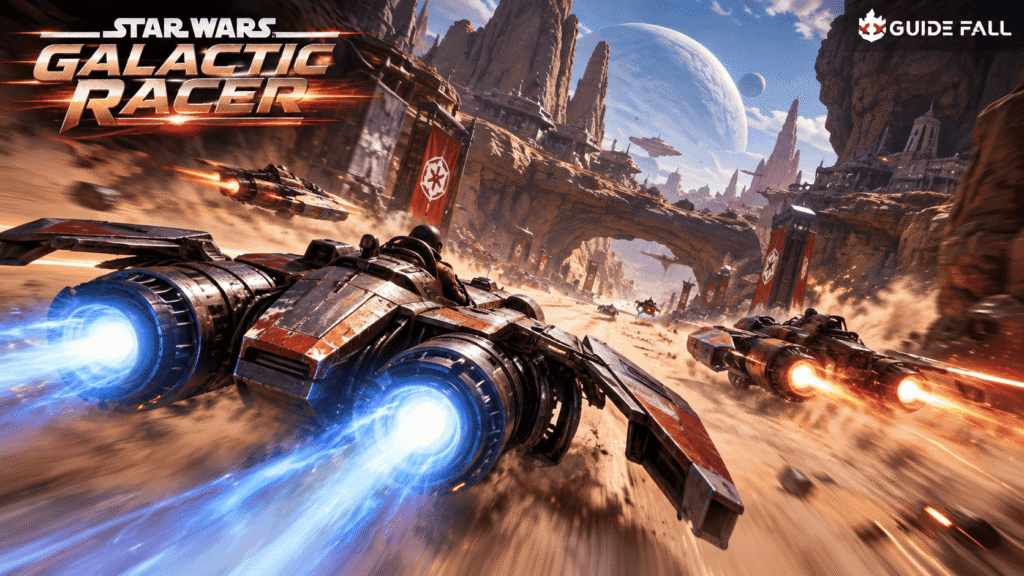
Players can choose from four types of repulsorcraft: landspeeders, speeder bikes, skim speeders, and podracers.
They don’t just look different. Each class is designed around its own handling characteristics and driving style.
Landspeeders offer a different experience from the slimmer, more agile speeder bikes. Meanwhile, skim speeders and podracers give players other ways to approach the track.
These differences matter because not everyone races the same way.
Some players prefer maintaining a steady pace and keeping their vehicle under control. Others enjoy taking risks, making aggressive moves, and overtaking opponents whenever an opportunity appears.
Galactic Racer also allows players to customize their vehicles to better suit their preferred racing style.
However, having several vehicle classes doesn’t automatically make a racing game more enjoyable.
If one vehicle turns out to be significantly stronger than the others, competitive players may end up using it almost exclusively.
On the other hand, if every class has meaningful strengths and weaknesses, players will have more reasons to experiment and develop new strategies.
Finding that balance will be especially important in multiplayer.
Crashing Into Rivals Isn’t Always a Mistake
In most racing games, hitting another vehicle is something players try to avoid.
A collision might cost speed, push the car off the racing line, or cause damage that makes the rest of the race more difficult.
Galactic Racer takes a different approach.
The game is built around aggressive competition. Players can push, ram, and knock rival vehicles around during races.
In other words, contact isn’t always something to avoid.
Sometimes, it can be part of the strategy.
Imagine two racers approaching a corner at almost the same speed.
One decides to slow down and maintain control. The other moves closer, hoping to push their opponent off the racing line.
Both are making different decisions, and neither is without risk.
This makes the outcome of each race harder to predict.
Still, the collision system needs to be handled carefully.
If knocking opponents aside is too easy and carries little risk, races could turn into chaotic demolition contests rather than tests of driving ability.
But if aggressive moves require good timing and careful judgment, every collision could become an important tactical decision.
That difference could determine whether the gameplay feels exciting or frustrating.
The Outer Rim Offers More Than One Kind of Racetrack
The Star Wars universe is filled with planets that have very different environments.
Some are covered in vast deserts, others feature frozen landscapes, and many contain dangerous terrain that can be difficult to navigate.
Galactic Racer uses this variety to create its racing environments.
Some of the locations featured in the game include Jakku, Tatooine, Ando Prime, Lantaana, Derven Acos, and Sentinel I.
Each location brings a different atmosphere to the races.
But scenery alone doesn’t make a good racetrack.
A well-designed track also needs its own personality.
For example, long stretches might favor vehicles that can maintain high speeds. Meanwhile, tracks filled with tight corners could reward players who choose more responsive vehicles.
This is where track design becomes especially important.
Players shouldn’t just memorize where the road goes. They should also learn when to accelerate, when to slow down, and when taking an alternative route might be worth the risk.
If the environments and vehicle classes complement each other, every planet could present a fresh challenge.
But if the differences are mostly limited to scenery and terrain colors, the variety might not be enough to keep players interested over time.
Campaign and Multiplayer Face Different Challenges
Galactic Racer features a story-driven campaign following Shade’s journey.
Players will compete in races while also following the changing relationships between characters.
According to the official website, shifting alliances play a role in the campaign, suggesting that Shade’s relationships with other racers will be part of the story.
Outside the campaign, the game also offers PvP racing against other players.
Both modes have their own appeal.
Multiplayer places greater emphasis on reacting to unpredictable decisions made by real opponents.
However, including two modes doesn’t guarantee that both will be equally enjoyable.
In the campaign, players follow the story and character development while working toward the main objective.
Multiplayer presents a different set of challenges.
Vehicle balance, collision mechanics, connection quality, and track design can all affect the competitive experience.
Racing against computer-controlled opponents might be fun, but competing against real players could feel very different.
The quality of both modes will become clearer once players have had the opportunity to try them.
Does Star Wars Need Another Racing Game?
Star Wars has appeared in plenty of video games over the years.
Many of its best-known titles focus on warfare, exploration, or lightsaber combat.
But the Star Wars universe is much bigger than the conflict between Jedi and Sith.
It’s also home to traders, bounty hunters, mechanics, smugglers, and ordinary people trying to make a living across countless planets.
Racing offers another way to explore that side of the galaxy.
Longtime fans may remember Star Wars Episode I: Racer, which brought high-speed podracing to video games.
Galactic Racer has an opportunity to expand on that idea with more vehicle classes, a new story, and a more aggressive style of competition.
But nostalgia alone won’t be enough.
The game still needs satisfying controls, interesting tracks, and gameplay that gives players a reason to return after finishing a few races.
The Star Wars name might attract attention, but the quality of the racing will determine whether players stick around.
Plenty of Potential, but Questions Remain
Based on what’s been revealed, Galactic Racer has several promising ideas.
The underground racing scene of the Outer Rim offers a different atmosphere from most Star Wars stories. Shade’s journey introduces a personal conflict, while the vehicle classes create opportunities for different racing styles.
The collision mechanics and PvP competition could also make races more aggressive and unpredictable.
However, these features need to work well together.
An interesting story won’t help much if the racing feels dull. The same goes for impressive-looking vehicles that are frustrating to control because of inconsistent mechanics.
Galactic Racer’s biggest challenge isn’t simply making vehicles go fast.
It’s making players feel that their decisions matter during every race.
When should they overtake? When is it better to defend their position? Which vehicle should they choose? And how much risk is worth taking?
If the game gets these details right, it could deliver an experience that stands apart from other Star Wars titles.
Final Thoughts
Star Wars: Galactic Racer takes players to a part of the galaxy that rarely gets the spotlight.
There’s no mission to save the universe or expectation to become a legendary hero. Instead, players follow a racer trying to survive a dangerous competition while dealing with personal problems from the past.
The Galactic League brings together people driven by ambition, money, rivalry, and power. Every race is about more than simply crossing the finish line.
Still, a promising concept needs strong execution.
Vehicle handling, competitive balance, track design, and character development will ultimately determine whether Galactic Racer delivers a satisfying racing experience.
Star Wars: Galactic Racer is scheduled for release on October 6, 2026, for PC, PlayStation 5, and Xbox Series X|S.
For now, the game offers an intriguing idea: a Star Wars experience where driving skills matter more than the Force.
And for Shade, winning the championship might only be the beginning of a much bigger problem.