
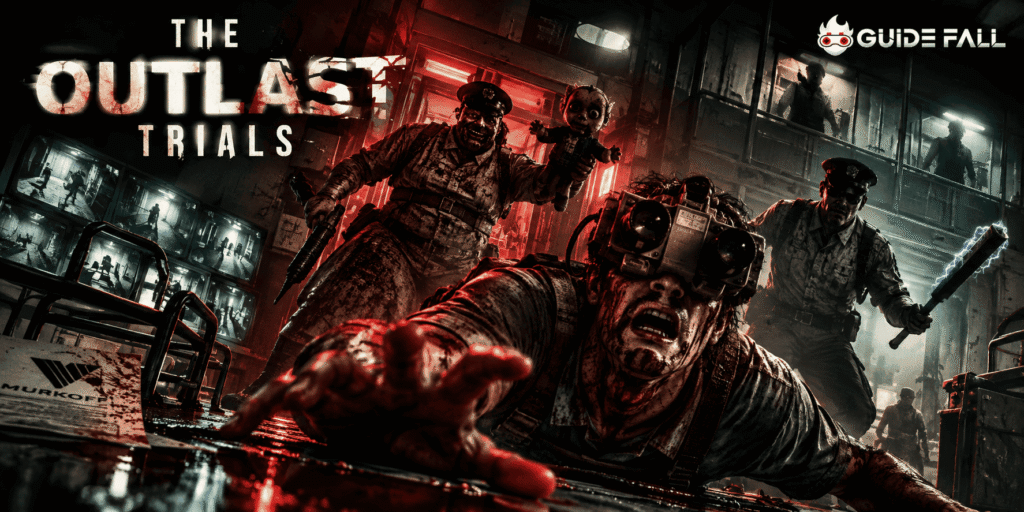

When Human Lives No Longer Matter
Imagine being offered a chance to start over.
Your past mistakes could be forgotten, your old identity left behind, and a better future might finally be within reach.
But there’s a catch nobody tells you about.
To get that second chance, you must surrender yourself to a corporation conducting secret experiments on human beings.
That’s the disturbing premise behind The Outlast Trials, a survival horror game developed by Red Barrels.
Set during the Cold War, the game introduces Murkoff Corporation, an organization that conducts experiments designed to manipulate human behavior and psychological responses.
The people caught up in these experiments are known as Reagents.
They’re not trained soldiers or experienced fighters. Many are vulnerable individuals looking for an opportunity to rebuild their lives.
Unfortunately, their hopes lead them somewhere far worse.
Inside Murkoff’s facility, people are no longer treated as individuals with rights or personal freedom. Instead, they become test subjects in experiments designed to push the limits of human fear, stress, and suffering.
What makes the story disturbing isn’t simply the corporation’s cruelty. It’s how Murkoff takes advantage of people’s hopes and uses them as a means of control.
Experiments Designed to Break the Human Mind
Every trial in The Outlast Trials comes with objectives that players must complete.
At first, some tasks seem fairly straightforward. Players might need to find specific items, activate equipment, move objects, or reach a designated location.
The problem is that almost nothing can be done safely.
The experimental environments are filled with dangers. Enemies patrol different areas, while traps can injure players or ruin their chances of escaping.
Murkoff has also constructed environments that resemble familiar places from everyday life.
However, these locations have been transformed into disturbing experimental spaces filled with violence.
Places that should feel ordinary become sources of fear.
Players may find themselves moving through dark hallways, entering cramped rooms, or searching for a way through areas occupied by dangerous enemies.
Things become even more stressful because there’s no guarantee of what lies behind the next door.
This is where The Outlast Trials builds much of its tension.
Fear doesn’t always come from being attacked. Sometimes, hearing footsteps in the next room is enough to make someone stop moving.
The game uses uncertainty to keep players on edge.
Fighting Isn’t Always an Option
In many horror games, players eventually gain access to weapons that help them deal with enemies.
As the game progresses, those weapons often become more powerful.
The Outlast Trials takes a different approach.
Players aren’t equipped with conventional weapons to kill their pursuers. Staying alive depends more on avoiding danger than winning fights.
When an enemy approaches, hiding is often the smartest option.
Players can use hiding spots, turn off certain light sources, or find alternative routes to avoid being noticed.
But hiding forever isn’t a solution either.
Every trial has objectives that need to be completed. Constantly avoiding danger without making progress only leaves players stuck in the same place.
That creates an interesting dilemma.
When should someone take a risk, and when is it better to back away?
There’s no single answer that works every time.
Sometimes, running is the best decision. In other situations, making too much noise could attract even more enemies.
Players need to understand their surroundings, watch enemy movements, and react to whatever is happening.
Rather than testing reflexes alone, the game also rewards patience and awareness.
Facing Enemies with Different Behaviors
Some of the biggest threats in The Outlast Trials come from the dangerous individuals Murkoff uses to terrorize and control the Reagents.
Several of these characters have particularly recognizable appearances and personalities.
Mother Gooseberry, for example, is a disturbing figure who carries a hand puppet named Dr. Futterman.
Her appearance is bizarre, but there’s nothing entertaining about what she does to her victims.
Then there’s Sergeant Coyle, a former law enforcement officer who attacks people with an electric baton.
Both characters present different kinds of danger.
Their presence also shows how Murkoff uses violent individuals as part of its experiments.
However, recognizing an enemy’s appearance isn’t enough to stay alive.
Players need to learn where enemies usually patrol, listen for nearby sounds, and figure out when it’s safe to move.
One small mistake can quickly turn a manageable situation into a disaster.
On the other hand, being overly cautious can also cause problems. Players who spend too much time watching enemies may miss opportunities to complete objectives while an area is clear.
Finding the right balance between caution and taking risks is an important part of the experience.
Survive Alone or Rely on Friends?
Unlike previous Outlast games, which focused on single-player experiences, The Outlast Trials supports cooperative play for up to four players.
Having teammates comes with several advantages.
Players can divide responsibilities, help friends in trouble, and work together to complete objectives.
If one player is being chased, the others might use that opportunity to finish a task elsewhere.
But teamwork doesn’t automatically make things easier.
The more people involved, the greater the chance of miscommunication.
Someone might move too quickly, enter an unchecked room, or attract an enemy while the rest of the group is trying to hide.
One bad decision can ruin everyone’s plan.
That’s what makes playing with friends feel different from surviving alone.
In solo play, players have complete control over their actions. Every decision comes down to their own judgment.
Cooperative play, meanwhile, requires communication and trust.
Interestingly, having friends around can also change the atmosphere.
That doesn’t mean the horror disappears. Instead, fear feels different when there’s someone else sharing the danger.
Equipment That Helps Players Stay Alive
Although players don’t have conventional weapons, they can still access equipment designed to help them survive Murkoff’s experiments.
One of the game’s important mechanics involves devices called Rigs.
These provide special abilities that can be used in different situations.
For example, the Stun Rig can temporarily interrupt or disable enemies, while the Heal Rig helps restore health.
These abilities give players more room to develop their own strategies.
Someone who prefers avoiding confrontation might choose equipment that improves their chances of escaping danger.
Meanwhile, players who regularly support their teammates may prefer abilities that are useful during emergencies.
Still, equipment doesn’t guarantee survival.
Each ability has usage limits, so players need to save it for moments when it matters most.
Besides Rigs, players can collect useful items scattered throughout the trials.
Because supplies are limited, they must decide whether to use an item immediately or save it for later.
This adds resource management to the experience without turning the game into a traditional combat-focused horror title.
Why Atmosphere Matters More Than Jump Scares
Horror games are often associated with enemies suddenly appearing out of nowhere.
These moments can certainly startle players, but the fear they create usually fades quickly.
The Outlast Trials tries to maintain tension through its environments and the situations players encounter.
Limited lighting makes it difficult to see everything nearby.
Distant sounds may suggest that an enemy is approaching, but they don’t always reveal exactly where the threat is coming from.
Narrow corridors and confined spaces can also make escaping more difficult.
Together, these elements create tension even when no enemies are visible.
Players might know exactly where they need to go but still hesitate before crossing an unfamiliar hallway.
The way Red Barrels builds its horror atmosphere is one of the game’s biggest strengths.
It doesn’t always need sudden surprises to make players uncomfortable.
Sometimes, simply knowing that something terrible could happen at any moment is enough.
However, this approach also has a weakness.
After repeating the same trials several times, players may become familiar with the environments, enemy behavior, and objectives.
That familiarity can reduce the fear they experienced during their first attempt.
Because of this, one of the game’s biggest challenges is maintaining enough variety to keep experienced players feeling vulnerable, even after they’ve learned how everything works.
Murkoff Corporation and the Illusion of Freedom
Behind the disturbing experiments lies a question that makes the story of The Outlast Trials particularly interesting.
Are the Reagents really working toward freedom?
Murkoff presents its experiments as a process that can help people change and begin a new life.
Yet its methods involve torture, psychological manipulation, and the destruction of personal identity.
Players are constantly encouraged to complete trials and advance to the next stage.
Every successful experiment seems to bring them closer to freedom.
But there’s a bigger problem.
Are they truly free if Murkoff still controls them?
This question sits at the heart of the game’s themes.
Murkoff isn’t simply trying to control people through physical violence. The corporation also wants to influence how they think, make decisions, and understand themselves.
Its experiments can be viewed as an extreme example of power being abused.
Vulnerable people are promised an opportunity to change their lives, only to lose control over those lives entirely.
This gives players a reason to pay attention to the story rather than simply completing objectives and escaping enemies.
Is The Outlast Trials Worth Playing?
The Outlast Trials offers a different experience from many survival horror games that focus heavily on combat.
Its greatest strengths come from its oppressive atmosphere, disturbing enemy designs, and gameplay that encourages players to think before acting.
The option to play alone or with friends also adds variety.
Players who enjoy personal challenges can attempt to survive Murkoff’s experiments without help.
Those who prefer cooperative games can work together to complete objectives while dealing with unpredictable situations.
However, the game might not appeal to everyone.
Players looking for traditional combat or a story that constantly moves forward through entirely different missions may find the experience less satisfying.
The repeated trial structure can become tiring, especially for those who care more about exploring a narrative than improving their skills or mastering gameplay mechanics.
Its graphic violence and disturbing psychological themes are also intense, meaning even some horror fans may find parts of the experience uncomfortable.
Ultimately, The Outlast Trials isn’t about how many enemies players can defeat.
It’s about how people react when they’re placed in situations where they have very little control.
Players must decide when to hide, when to move, and when to take risks to complete their objectives.
Throughout these experiments, Murkoff continues promising change and freedom.
But after witnessing what the corporation does to its victims, one question remains difficult to ignore.
If someone finally escapes Murkoff’s facility, will they still be the same person who entered it?