

Within seconds, a simple piece of food has become more valuable than the weapons scattered across the battlefield. You recover enough health to continue fighting, defeat another officer, and push toward victory.
It is a ridiculous situation when viewed outside the context of a video game. Yet players accept it almost instinctively.
Food restores health. Meals provide bonuses. Cooking prepares characters for dangerous adventures. A plate of something delicious can turn an impossible battle into a manageable one.
These mechanics are so familiar that we rarely question them.
But food in video games does far more than refill a health bar. It can shape exploration, influence combat strategy, establish cultural identity, create memorable characters, and even change how players approach an entire virtual world.
Food might be one of the most overlooked tools in video game design, precisely because it feels so ordinary.
Food Has Always Been More Than a Health Potion
In many classic games, food served an extremely practical purpose: keeping the player alive.
It was easy to understand. A character who had taken damage could eat something and recover health. There was no need for a complicated tutorial explaining why a meal might help someone regain strength.
That familiarity made food an effective design choice.
A glowing magical potion might fit naturally into a fantasy RPG, but a loaf of bread, an apple, or a roasted chicken can work across many different settings.
Food also provides an immediate visual language. Players generally understand that something edible is likely to be beneficial, even before they know its exact effect.
Over time, developers expanded this simple concept into systems involving ingredients, recipes, temporary buffs, resource management, and character relationships.
What began as a convenient healing item gradually became an important part of how games communicate their rules.
Dynasty Warriors and the Surprisingly Important Steamed Bun
Dynasty Warriors is a useful place to begin because its combat is anything but realistic.
A single officer can defeat enormous groups of enemy soldiers, perform spectacular attacks, and survive situations that would be impossible on a historical battlefield.
Within that exaggerated world, food items have long provided a simple form of recovery.
The steamed bun is particularly recognizable to players familiar with the series. Depending on the installment, food-related pickups and recovery items help players remain in battle without interrupting the action for lengthy inventory management.
That simplicity is important.
Dynasty Warriors is built around momentum. Players move between objectives, defeat enemy officers, and respond to changes across the battlefield.
A complicated healing system could interfere with that rhythm.
Instead, a recognizable pickup communicates its purpose quickly and allows the player to continue fighting.
There is also a cultural dimension to the choice.
The games draw heavily from the Three Kingdoms period of Chinese history, even though their presentation is deliberately theatrical and fictionalized.
Food associated with Chinese culinary traditions can reinforce that setting without requiring a lengthy explanation.
For readers interested in this particular connection, Arrows Restaurant explores why steamed buns became such an iconic food item in Dynasty Warriors, connecting the familiar healing pickup with the series’ broader identity.
It is a small example of how a basic gameplay object can become part of a franchise’s personality.
Why Simple Healing Items Work So Well
Good game design often relies on mechanics that players can understand without stopping to think.
Food is especially effective because its function is familiar.
When a character eats something, players expect some kind of benefit. That expectation reduces the amount of explanation a game needs to provide.
However, the real value lies in how the item affects decisions.
Consider a player entering a difficult combat encounter with limited healing supplies.
Should they use their remaining food immediately, or save it for a more dangerous moment?
Should they explore another room in the hope of finding supplies, or continue toward the objective?
Even a simple recovery item creates meaningful choices when availability is limited.
Food becomes more than a resource. It becomes part of the game’s risk-management system.
Monster Hunter Turns Eating Into Battle Preparation
Monster Hunter takes a different approach.
Rather than treating food primarily as something consumed in the middle of combat, the series often emphasizes meals as preparation for a hunt.
Players can eat before facing dangerous monsters, receiving benefits that vary according to the particular game and meal system.
This creates an interesting relationship between preparation and performance.
A difficult encounter does not begin when the player draws their weapon. It begins earlier, when they select equipment, gather supplies, and prepare their character.
Food becomes part of that preparation.
The elaborate cooking animations also serve another purpose.
They give the player a moment of comfort before a potentially stressful encounter.
There is something memorable about watching a character enjoy an enormous meal before confronting a monster many times their size.
The contrast is entertaining, but it also establishes a rhythm: prepare, eat, hunt, return, and prepare again.
This rhythm helps make the hunting experience feel like a complete activity rather than an uninterrupted series of battles.
Food Can Make Preparation Feel Like a Skill
Many action games reward quick reactions and mechanical execution.
Food systems can reward a different ability: planning.
A player who understands an upcoming encounter may select a meal that supports a particular strategy.
Someone preparing for a long exploration session might prioritize different benefits from someone expecting a difficult boss fight.
These decisions become especially interesting when food effects are temporary.
The player must consider not only what to eat, but when to eat it.
Using a valuable meal too early can waste its benefits. Saving it indefinitely can be equally inefficient.
This adds a layer of resource management without necessarily requiring complex controls.
At its best, a food system rewards players for understanding the challenges ahead.
Breath of the Wild Makes Cooking Part of Exploration
The Legend of Zelda: Breath of the Wild demonstrates how cooking can connect several different systems.
Players gather ingredients from the environment, combine them into meals, and use the results to support exploration and combat.
Food can restore health, while particular recipes can provide useful effects such as resistance to environmental conditions or temporary enhancements.
This changes how players interact with the world.
A mushroom is not simply scenery. A fish is not merely decorative wildlife. Ingredients can become useful resources that encourage players to investigate their surroundings.
Exploration feeds into cooking, and cooking makes further exploration possible.
The result is a satisfying gameplay loop.
A player might gather ingredients in a relatively safe region, prepare suitable meals, and then attempt to explore an area that previously seemed too dangerous.
Instead of treating the environment as a background, the game encourages players to understand and use it.
Why Cooking Encourages Experimentation
Cooking systems can also reward curiosity.
When players are allowed to combine ingredients, they naturally begin asking questions.
What happens if these two ingredients are cooked together?
Will adding another ingredient improve the result?
Can an unfamiliar resource produce a useful effect?
These questions encourage experimentation without requiring combat.
Importantly, experimentation creates a different kind of satisfaction from receiving a random reward.
The player is actively testing an idea.
When the result is useful, they can feel that their understanding of the game has improved.
That feeling is particularly valuable in open-world games, where players benefit from having reasons to engage with their surroundings beyond following map markers.
Survival Games Make Food a Question of Priorities
In survival games, food often serves a more demanding role.
Players may need to manage hunger, gather ingredients, hunt animals, cultivate crops, or maintain reliable supplies.
These systems can create tension because resources are limited.
A player might need to decide whether to spend time gathering food or continue building shelter.
They may have to choose between exploring a dangerous area and returning home before their supplies run out.
Food therefore becomes part of the game’s economy of time and risk.
However, survival mechanics are not automatically enjoyable.
If hunger decreases too quickly, players can feel trapped in repetitive maintenance tasks.
Instead of exploring or building, they may spend most of their time preventing an inconvenient meter from reaching zero.
The challenge is finding a balance where food creates meaningful decisions without constantly interrupting more interesting activities.
Valheim Makes Food Part of Character Development
Valheim offers a particularly interesting approach to food.
Rather than functioning solely as a conventional hunger punishment, meals contribute to the player’s available health and stamina.
Different foods support different priorities, encouraging players to choose combinations based on what they intend to do.
A player preparing for a dangerous fight might prioritize survivability.
Someone focused on movement or resource gathering may prefer a different balance.
Food becomes closely connected to character capability.
This makes cooking and ingredient gathering important even after the player has established a relatively secure base.
As progression continues, access to better food can become part of the reward for exploring new areas and developing more advanced production systems.
The important point is that food supports the larger progression structure.
It is not simply a timer demanding attention. It is a resource that allows players to prepare for increasingly difficult challenges.
Final Fantasy XV Makes Food Part of the Adventure
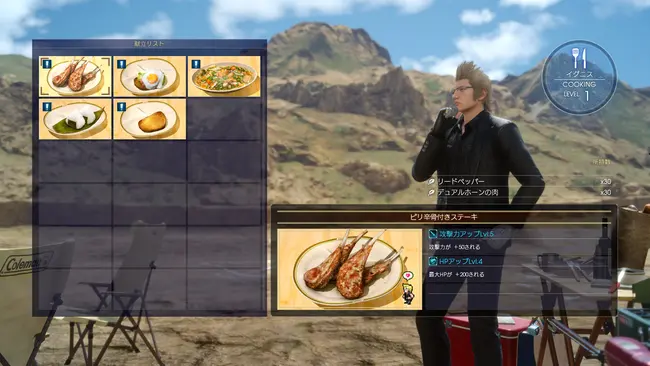
Final Fantasy XV shows how food can contribute to storytelling.
The game follows Noctis and his companions on a journey that includes battles, exploration, travel, and quieter moments between major events.
Meals prepared during camping sequences are memorable partly because they reinforce the relationships between the characters.
Ignis’s cooking becomes a recognizable part of the group’s identity.
The detailed food presentation also makes ordinary activities feel unusually important.
Players are not merely watching statistics increase. They are seeing companions share a meal after traveling together.
These moments help establish the feeling of a road trip.
They also provide contrast with the game’s more dramatic story developments.
Without quieter experiences, a long adventure can begin to feel like a continuous sequence of combat encounters and cutscenes.
Food offers an opportunity to slow the pace and remind players that characters have lives beyond fighting.
Why Food Can Make Fictional Characters Feel More Human
Video game characters often perform extraordinary actions.
They defeat monsters, survive impossible injuries, explore hostile worlds, and carry equipment that would be impractical in reality.
These abilities make them exciting, but they can also make them feel distant from ordinary human experience.
Eating provides a point of familiarity.
A character enjoying a favorite meal, complaining about bad cooking, or preparing food for a friend can reveal personality without requiring a dramatic speech.
Small interactions around food can communicate friendship, culture, routine, and personal preference.
This is particularly useful in role-playing games with large casts.
Not every character needs a lengthy backstory to feel distinctive.
Sometimes a simple conversation over dinner can reveal more about a relationship than another battle sequence.
Food Is Also a Form of World-Building
Consider what the cuisine of a fictional world can tell us.
A coastal settlement might rely heavily on fish and seafood.
A farming community might prepare meals from grain, vegetables, and domesticated animals.
A harsh mountain region might feature preserved ingredients that reflect difficult living conditions.
These details can make a setting feel more believable.
They suggest that people live in the world even when the player is not watching.
Food can also communicate social differences.
A wealthy household might serve elaborate dishes, while travelers or soldiers rely on simple, portable supplies.
These contrasts can reveal aspects of an economy or culture without requiring an encyclopedia entry.
When developers use food thoughtfully, it becomes environmental storytelling.
The Problem With Food Systems That Add Nothing
Despite these possibilities, not every cooking mechanic improves a game.
Some titles introduce elaborate recipe systems that offer little meaningful benefit.
Players collect ingredients, navigate menus, and produce meals that are barely more useful than ordinary healing items.
In such cases, the system may create unnecessary friction.
A mechanic does not become interesting simply because it contains many ingredients or recipes.
Complexity needs a purpose.
If cooking is supposed to support exploration, its rewards should meaningfully influence exploration.
If it is intended to encourage preparation, players should benefit from making informed decisions.
If it primarily supports immersion, the presentation and interactions should contribute to the atmosphere.
Without a clear purpose, cooking risks becoming another checklist activity.
When Food Becomes Inventory Clutter
Inventory management is one of the most common frustrations in games with extensive crafting systems.
Players may accumulate dozens of ingredients, meals, and consumables while struggling to remember which ones are useful.
Some items remain untouched because the player is saving them for a future challenge.
Others become obsolete as better recipes are unlocked.
Eventually, the inventory may contain more food than the character could reasonably consume.
This creates a design problem.
A system intended to encourage resourcefulness can instead discourage players from interacting with it.
Clear item descriptions, convenient sorting, sensible stacking rules, and straightforward cooking interfaces can make a significant difference.
Developers should not underestimate how much interface design affects the enjoyment of an otherwise interesting mechanic.
Why Players Hoard Their Best Food and Never Use It
Many RPG players are familiar with the temptation to save powerful consumables for later.
A rare meal might provide an impressive temporary bonus, but using it feels wasteful when the current encounter seems manageable.
The player decides to save it for a more difficult fight.
Then another difficult fight arrives, and the same reasoning applies.
Eventually, the game ends with the valuable item still sitting in the inventory.
This behavior reveals an interesting contradiction.
Consumables are designed to be used, yet scarcity can make players reluctant to consume them.
Developers can address this by making useful ingredients renewable, providing clear opportunities to use special meals, or designing encounters where preparation offers a noticeable advantage.
The goal is not necessarily to make every resource abundant.
It is to make using the resource feel like a sensible decision rather than a permanent loss.
Can Food Mechanics Make Combat More Strategic?
Food can improve combat design when it introduces choices beyond simply restoring health.
Temporary resistance effects might encourage players to prepare for a particular enemy.
Stamina-related benefits can support movement-heavy strategies.
Other meals may reward players who understand the challenges of a specific region or encounter.
However, the bonuses need to be balanced carefully.
If one recipe is overwhelmingly superior in nearly every situation, the apparent variety becomes meaningless.
Players will simply prepare the same meal repeatedly.
More interesting systems create genuine trade-offs.
Choosing one benefit should sometimes mean giving up another.
That makes food part of character customization rather than an automatic statistical upgrade.
Why Food Works Differently Across Game Genres
The purpose of food changes depending on the type of game.
| Game or Genre | Role of Food | Effect on Gameplay |
|---|---|---|
| Dynasty Warriors | Health recovery | Keeps battles moving without lengthy interruptions |
| Monster Hunter | Pre-hunt preparation | Encourages planning before difficult encounters |
| Breath of the Wild | Cooking and environmental benefits | Connects ingredient gathering with exploration |
| Valheim | Health and stamina support | Influences survival preparation and progression |
| Final Fantasy XV | Meal bonuses and character interaction | Supports progression, atmosphere, and storytelling |
These differences explain why food should not be evaluated as one universal mechanic.
A simple healing pickup can be perfectly suited to a fast-paced action game.
The same simplicity might feel disappointing in a survival RPG built around crafting and resource management.
Good design depends on what the game is trying to accomplish.
Should Every RPG Have a Cooking System?
No.
Although cooking can improve immersion and strategic depth, it is not automatically appropriate for every role-playing game.
Some RPGs focus on dialogue, exploration, and narrative decisions.
Others emphasize combat mastery or tightly structured progression.
Adding an elaborate cooking system to a game that does not need one may distract from its strongest features.
There is also a difference between including food in a fictional world and requiring players to manage it.
A game can use restaurants, meals, and food-related dialogue to establish atmosphere without introducing ingredient collection or crafting menus.
The question should never be whether a game has enough mechanics.
It should be whether those mechanics contribute to the experience the developers want to create.
The Best Food Mechanics Connect Multiple Parts of a Game
The most memorable food systems rarely exist in isolation.
They connect different activities.
In Breath of the Wild, exploration provides ingredients that help players survive further exploration.
In Monster Hunter, eating supports the preparation that precedes a dangerous hunt.
In Valheim, food production contributes to the broader cycle of gathering, building, exploration, and progression.
In Final Fantasy XV, meals combine mechanical benefits with character interaction.
Even the humble steamed bun in Dynasty Warriors connects visual identity with the practical need to maintain combat momentum.
These systems work because food supports something the player already cares about.
It does not exist merely to occupy another inventory slot.
Could Future Games Make Food Even More Interesting?
There is still considerable room for experimentation.
Developers could create cooking systems that respond more directly to regional cultures, environmental conditions, or character preferences.
Meals could influence relationships between companions or provide clues about the history of a fictional settlement.
Survival games could offer more meaningful alternatives between hunting, farming, fishing, and trading rather than making one resource-gathering method universally superior.
Role-playing games could use food preparation to create quiet moments between major story events.
However, more realism would not necessarily produce better results.
Requiring players to manage every detail of nutrition might be appropriate for a highly specialized survival simulation, but exhausting in a fast-paced action RPG.
The most promising direction is not simply making food more complicated.
It is making food more meaningful.
Conclusion: Food Is a Small Mechanic With an Enormous Influence
Food rarely receives the same attention as combat systems, character progression, or open-world design.
Yet it can influence all three.
A steamed bun can keep a Dynasty Warriors battle moving.
A carefully chosen meal can help a Monster Hunter player prepare for a difficult encounter.
A cooked dish in Breath of the Wild can turn a dangerous region into an opportunity for exploration.
Food can also reveal the personality of a character, establish the culture of a fictional world, or provide a welcome moment of calm between major events.
Of course, not every game needs elaborate cooking mechanics. Poorly designed food systems can become repetitive chores or unnecessary inventory clutter.
But when developers understand the purpose of food within their games, even the simplest meal can become memorable.
Perhaps that is what makes food such an underrated mechanic.
Players often remember the spectacular boss fights, dramatic stories, and powerful weapons. They rarely stop to consider how much of their adventure depended on a handful of ingredients or a convenient healing item.
Sometimes, the difference between a frustrating game and a satisfying adventure is not a legendary sword or an extraordinary ability. It is knowing when to stop, prepare a meal, and get ready for what comes next.