

But what happens when another player defeats the same boss using a powerful bleed build, a carefully optimized weapon, or a Spirit Ash that draws the enemy’s attention?
Did that player overcome the challenge, or simply find a way around it?
This question has followed Elden Ring since its release. Discussions about overpowered weapons, magic builds, summons, and so-called easy-mode strategies often turn into arguments about how the game is supposed to be played.
Some players believe that relying on unusually strong builds removes the satisfaction of mastering difficult encounters. Others argue that discovering powerful strategies is itself a form of mastery.
Both perspectives raise interesting questions, but they often overlook something fundamental about Elden Ring.
The game does not simply challenge players to become better at fighting. It also challenges them to understand its systems, explore its world, and decide how they want to approach danger.
What Actually Makes a Build Overpowered in Elden Ring?
The term “overpowered” is used so frequently in gaming discussions that its meaning can become unclear.
Sometimes it describes a weapon that deals unusually high damage. In other situations, it refers to a combination of equipment, attributes, and abilities that makes difficult encounters significantly more manageable.
But strength alone does not necessarily make a build overpowered.
A character with high damage might have limited defensive capabilities. A powerful spell may require substantial resource investment or leave the player vulnerable during casting.
Some strategies are extremely effective against particular enemies but much less useful against others.
In Elden Ring, the effectiveness of a build depends on several interacting factors:
- Weapon upgrades and attribute scaling.
- Talismans and their effects.
- Damage types and enemy resistances.
- Status effects such as blood loss or frostbite.
- Weapon skills and spell combinations.
- Character level and available resources.
- The player’s understanding of positioning, timing, and enemy behavior.
These factors make the concept of an overpowered build more complicated than simply identifying the weapon with the highest damage number.
A build can be exceptionally strong in one situation without being universally effective.
Rivers of Blood and the Rise of Bleed Builds
Few weapons illustrate Elden Ring’s build debates as clearly as Rivers of Blood.
The katana became widely associated with powerful bleed-focused strategies, particularly during the game’s earlier balance periods.
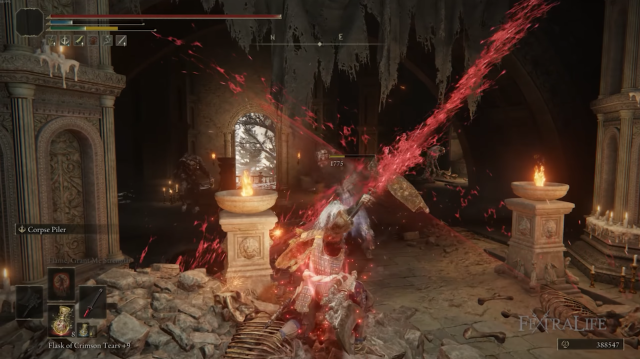
Its weapon skill, Corpse Piler, allows players to perform a series of blood-themed slashes that can apply pressure and contribute to blood loss buildup.
Against enemies susceptible to blood loss, this style of combat can be extremely effective.
However, the weapon’s reputation should be understood in context.
Elden Ring has received numerous balance updates since launch, and the relative effectiveness of individual weapons has changed over time. A build described as dominant in an older guide may not perform identically in a newer version.
That distinction matters because players sometimes discuss Rivers of Blood as though its original reputation describes every version of the game.
For players interested in the equipment and stat choices associated with this weapon, Good Old Days Farm’s Rivers of Blood build guide provides a more specific starting point for exploring the weapon’s bleed-oriented playstyle.
But the larger question is not whether Rivers of Blood can be powerful.
It is whether choosing a powerful weapon makes a player’s victory less meaningful.
Is Using a Strong Weapon Really Different From Learning a Boss?
Imagine two players fighting the same boss.
The first uses a relatively simple melee weapon and spends several hours learning every attack pattern. They carefully dodge each strike and eventually win through consistent execution.
The second explores extensively, upgrades a powerful weapon, adjusts their talismans, and chooses a build that exploits the boss’s weaknesses.
They defeat the boss after only a few attempts.
Which player demonstrated more skill?
The answer depends on what kind of skill we are measuring.
The first player demonstrated mechanical precision, patience, and the ability to learn attack patterns.
The second demonstrated preparation, experimentation, resource management, and an understanding of the game’s systems.
Both approaches involve decisions and learning.
They simply emphasize different abilities.
This is one of Elden Ring’s most important design characteristics: players can often solve the same problem in different ways.
Elden Ring Was Designed Around Player Freedom
Unlike Sekiro: Shadows Die Twice, Elden Ring gives players considerable freedom in how they develop their characters.
Players can use heavy weapons, quick weapons, sorceries, incantations, ranged attacks, shields, status effects, and various combinations of these tools.
They can also leave difficult encounters, explore elsewhere, improve their equipment, and return later.
This flexibility is not an accidental side effect.
It is central to the game’s open-world structure.
If a boss proves too difficult, the player is not always required to repeat the same encounter until their execution improves.
They may instead discover a new weapon, obtain a useful talisman, increase their level, or change their strategy.
That creates a different relationship between difficulty and progression.
The game rewards both persistence and preparation.
When someone uses a powerful build to overcome an obstacle, they are participating in one of the game’s intended systems.
Whether that approach produces the most satisfying experience is a separate question.
Why Some Players Believe Overpowered Builds Ruin the Experience
The criticism of overpowered builds is not entirely unreasonable.
Boss encounters in FromSoftware games often feature elaborate animations, carefully designed attack sequences, and distinctive combat rhythms.
Learning those patterns can be one of the most rewarding parts of the experience.
When a build deals enough damage to end an encounter before the player has seen much of the boss’s moveset, some of that design may go unnoticed.
A powerful strategy can also reduce the need to engage with defensive mechanics.
If enemies are defeated quickly, the player may have fewer opportunities to practice dodging, positioning, or managing limited openings.
This can create an unusual situation where the player becomes stronger without necessarily becoming more familiar with the combat system.
For someone who enjoys mastering difficult encounters, that trade-off may feel disappointing.
The concern is not always that strong builds are unfair.
Sometimes it is that they allow players to miss the very experiences those players might have enjoyed most.
But Does Every Player Need the Same Experience?
This is where the argument becomes more complicated.
Not everyone plays Elden Ring for the same reason.
Some players enjoy demanding boss battles and want to overcome them through precise execution.
Others are more interested in exploring the Lands Between, discovering hidden locations, collecting equipment, or learning about the game’s mysterious characters.
A player fascinated by the world might see a difficult boss as an obstacle standing between them and another region they want to explore.
For that player, finding an effective build may improve the experience rather than diminish it.
The same encounter can serve different purposes for different audiences.
One person sees a test of mechanical skill.
Another sees a problem to solve using the resources available.
Neither interpretation automatically invalidates the other.
Spirit Ashes and the Argument Over Playing the Right Way
Spirit Ashes have generated similar debates.
Summoning a spirit can change the dynamics of a boss encounter by providing additional damage, drawing enemy attention, or creating opportunities to heal and attack.
For some players, this significantly reduces the pressure of fighting alone.
Critics argue that summons can interfere with the intended rhythm of certain encounters.
Supporters point out that Spirit Ashes are an explicit gameplay system, complete with upgrade materials, resource costs, and different tactical applications.
The important distinction is between a personal challenge preference and a universal rule.
A player who enjoys solo combat can choose not to summon.
That preference can make their own victories more satisfying.
But it does not follow that every player using Spirit Ashes is playing incorrectly.
Elden Ring provides these tools, and deciding whether to use them is itself part of the experience.
Difficulty Is Not the Same Thing as Quality
There is a tendency in some gaming communities to treat greater difficulty as evidence of a better experience.
But difficulty is only one component of game design.
A boss can be extremely difficult because its attacks demand precise timing and thoughtful responses.
It can also be difficult because of poor visibility, inconsistent camera behavior, or frustrating mechanics.
These are not equivalent experiences.
Likewise, a relatively easy encounter can still be memorable because of its atmosphere, music, narrative significance, or unusual mechanics.
The quality of a boss fight should not be measured solely by the number of attempts required to win.
What matters is how the encounter challenges the player and whether overcoming it feels satisfying.
Sometimes a powerful build can make an encounter less interesting.
Other times, it can remove frustration and allow the player to appreciate aspects of the game they would otherwise never reach.
The Difference Between Mechanical Skill and Strategic Skill
Much of the disagreement surrounding overpowered builds comes from treating skill as a single concept.
In reality, Elden Ring rewards several different forms of competence.
Mechanical Skill
This includes dodging attacks, managing stamina, maintaining proper spacing, recognizing animation cues, and responding accurately under pressure.
Strategic Skill
This involves understanding enemy weaknesses, selecting appropriate equipment, managing resources, and developing effective approaches to difficult encounters.
Exploration and Knowledge
Players who investigate optional areas may discover tools that dramatically change their available strategies.
Adaptability
Some players succeed because they recognize when their preferred approach is ineffective and are willing to try something different.
A player who defeats a boss using an optimized build may demonstrate less mechanical precision during that particular encounter.
But they may have invested considerable effort into understanding the systems that made their strategy effective.
Reducing both experiences to a simple distinction between skilled and unskilled players ignores that complexity.
Do Overpowered Builds Undermine Boss Design?
There is a legitimate design concern when a particular strategy consistently bypasses too many intended challenges.
Imagine a boss designed around careful movement, defensive timing, and recognizing openings.
If one widely available combination allows players to defeat it without meaningfully interacting with those mechanics, some of the encounter’s design becomes less relevant.
That does not necessarily mean the strategy should be removed.
But it raises questions about balance.
How much power should players be allowed to accumulate?
Should certain bosses resist strategies that dominate other encounters?
Should particularly strong abilities require greater trade-offs?
These are design decisions rather than moral judgments about the players who use those tools.
A healthy combat system should offer meaningful variety without allowing one option to make nearly every alternative feel pointless.
Why Balance Patches Change the Conversation
Elden Ring’s balance has evolved through updates affecting weapons, skills, spells, and other combat systems.
This means discussions about the strongest builds need to account for the version of the game being played.
A strategy that was unusually effective near launch might behave differently after later adjustments.
Similarly, new content can introduce enemies or encounters that challenge previously successful approaches.
This is particularly important when watching older build videos or reading guides.
A dramatic damage demonstration does not necessarily represent the weapon’s performance in the current version.
Players should examine when a guide was published, which patch it used, and whether its recommendations remain relevant.
Balance changes also reveal something important about developer intent.
When a particular strategy becomes too dominant, adjusting it can help preserve variety across the combat system.
But balance does not require every weapon to perform identically.
Different strengths and weaknesses are part of what makes character-building interesting.
The Problem With Following the Meta Without Understanding It
Online guides can be extremely useful.
They help players discover equipment interactions, understand attribute scaling, and avoid investing resources inefficiently.
However, following a popular build without understanding its purpose can create problems.
A player might copy an equipment setup designed for a specific level, playstyle, or encounter and then wonder why it performs poorly in their own situation.
They may also become dependent on a strategy that does not work against every enemy.
More importantly, copying a build can remove some of the satisfaction of experimentation.
Discovering an effective combination through personal experience can be rewarding in its own right.
There is nothing inherently wrong with using a guide.
But the best guides should help players understand why a build works, not merely provide a list of items to equip.
When Optimization Starts Feeling Like an Obligation
Another problem emerges when community discussions focus too heavily on efficiency.
Players may begin to feel that choosing a less powerful weapon is a mistake.
A weapon they find visually appealing might be dismissed because another option produces more damage.
An unusual playstyle might be considered inferior because it requires more effort.
Eventually, the conversation shifts from what is enjoyable to what is mathematically optimal.
This can make a game with enormous build variety feel surprisingly restrictive.
If everyone is encouraged to use the same few strategies, much of the game’s creative potential goes unexplored.
The strongest build is not always the most entertaining build.
And the fastest victory is not always the most memorable one.
Self-Imposed Challenges Can Be Valuable Without Becoming Rules for Everyone
Players who want a more demanding experience have numerous ways to create one.
They can avoid summons, limit character leveling, use less powerful equipment, or attempt encounters under unusual restrictions.
These challenges can reveal aspects of combat that would otherwise be easy to overlook.
They also demonstrate the flexibility of Elden Ring’s systems.
But self-imposed restrictions work best when they remain personal choices.
A player completing a difficult encounter without summons has achieved something worth appreciating.
That achievement does not require dismissing someone else’s victory.
Different challenge levels can coexist within the same game.
Indeed, the ability to create those experiences is one of the reasons Elden Ring supports such a wide range of playstyles.
Is Using an Overpowered Build Cheating?
In ordinary single-player play, using equipment and abilities provided by the game is not the same thing as cheating.
There is a meaningful difference between selecting a powerful weapon and using unauthorized software to alter game behavior.
There is also a distinction between intended mechanics and exploits that rely on unintended interactions.
Players may reasonably disagree about whether a particular exploit undermines the experience.
But simply optimizing attributes, equipment, and abilities does not automatically cross that line.
Competitive multiplayer introduces additional considerations because one player’s choices can directly affect another person’s experience.
Balance becomes especially important when unusually strong strategies reduce fair competition or meaningful counterplay.
That is a different issue from whether someone should use a powerful build to defeat a single-player boss.
What Sekiro Reveals About Elden Ring’s Difficulty
Comparing Elden Ring with Sekiro helps clarify why these arguments exist.
Sekiro emphasizes a more focused combat system built around deflection, posture, timing, and mastery of a relatively defined set of abilities.
Players have tools and upgrades, but they cannot fundamentally transform their character into a traditional spellcaster, heavy-armored tank, or bleed-focused RPG build.
This creates a more concentrated challenge.
Elden Ring takes a broader approach.
Its encounters must accommodate characters with very different weapons, ranges, damage types, and defensive options.
As a result, players can often change the difficulty of an encounter by changing their strategy.
Neither design philosophy is inherently superior.
Sekiro can provide a more tightly controlled test of combat execution.
Elden Ring can provide a more flexible test of preparation, exploration, and adaptation.
Expecting both games to reward exactly the same behavior overlooks what makes them distinct.
Could Elden Ring Be Better Without Overpowered Builds?
Removing the strongest builds might make some encounters more demanding.
But it could also reduce the range of approaches available to players.
There is an important difference between balancing a system and making every option equally difficult.
A well-balanced RPG does not necessarily require every build to defeat a boss in the same amount of time.
Different strategies should have different advantages.
A heavy weapon might reward careful timing with substantial damage.
A quick weapon might offer more frequent opportunities to attack.
A spellcaster might gain ranged options while facing different resource or positioning constraints.
The goal should be meaningful trade-offs.
If one strategy consistently offers exceptional damage, safety, and convenience without meaningful disadvantages, developers may have reason to adjust it.
But eliminating every unusually strong combination could make experimentation less exciting.
Part of the pleasure of an RPG is discovering that careful preparation can make your character feel genuinely powerful.
How to Decide Whether an OP Build Is Right for You
Instead of asking whether powerful builds are universally good or bad, players can ask what they want from the experience.
If You Enjoy Mastering Boss Mechanics
Consider using equipment that allows encounters to last long enough for you to learn their patterns.
You may find that avoiding certain high-damage combinations makes victories more satisfying.
If You Enjoy Character Optimization
Experiment with attribute scaling, talismans, weapon skills, and status effects.
Understanding how different systems interact can be a rewarding challenge of its own.
If You Mainly Want to Explore the World
There is nothing unreasonable about choosing powerful tools that help you progress through difficult encounters.
The game’s world, characters, and environmental storytelling remain valuable parts of the experience.
If You Are Struggling With a Particular Boss
Consider changing your approach before deciding that you have reached an impossible obstacle.
Upgrading equipment, adjusting defenses, exploring another region, or using available summons may provide a solution.
If a Powerful Build Makes the Game Boring
Try a different weapon or impose a personal restriction.
You do not need to abandon the game simply because one strategy has become too effective.
The Real Problem Is When Players Stop Experimenting
Elden Ring contains an enormous collection of weapons, spells, skills, and equipment combinations.
That variety creates opportunities for personal expression.
One player might build a heavily armored knight.
Another might focus on rapid attacks and status effects.
Someone else might prefer sorcery, incantations, or unconventional combinations that are difficult to categorize.
These choices make the game feel different from one playthrough to another.
The real loss occurs when players believe there is only one acceptable way to succeed.
That belief can emerge from either side of the difficulty debate.
Players who insist that everyone must avoid powerful tools can discourage experimentation.
Players who insist that everyone must follow the strongest available meta can do the same.
Both approaches reduce a flexible RPG to a narrow set of expectations.
A more interesting community recognizes that different players can pursue different kinds of mastery.
Conclusion: Overpowered Builds Do Not Automatically Ruin Elden Ring
Overpowered builds can change the difficulty of Elden Ring dramatically.
Some combinations may allow players to defeat bosses before fully understanding their attack patterns. Others can reduce the pressure of encounters that were designed to feel dangerous.
For players who value mechanical mastery above everything else, those advantages may diminish the satisfaction of victory.
But Elden Ring is not built around mechanical execution alone.
It is also a game about exploration, preparation, discovery, and adapting to a hostile world.
Finding a powerful weapon, understanding a status effect, or developing an effective strategy can be meaningful accomplishments.
The existence of strong builds does not automatically invalidate the game’s challenge. Instead, it gives players more control over how they approach that challenge.
Balance still matters. Strategies that overwhelm too many encounters without meaningful trade-offs can reduce variety and weaken combat design.
But the answer is not to treat every powerful build as a mistake or every player who uses one as less deserving of victory.
The best way to experience Elden Ring is not necessarily the hardest way, the easiest way, or the most efficient way. It is the approach that makes the journey through the Lands Between meaningful to you.
And if that means defeating a terrifying demigod with an optimized katana instead of spending another evening learning every attack animation, the victory is still yours.