
death usually acts as a limit. Make too many mistakes, and your journey is over.
But The Old Guard has a problem with that rule.
Its main characters are not supposed to stay dead.
They can be shot, stabbed, cut down, or suffer injuries that would normally kill someone.
A short time later, their bodies recover and they return to the fight.
Immortality is not there just to make the fights more exciting.
It is an important part of The Old Guard story.
So when Netflix brought the world of The Old Guard into a browser game in 2020,
an interesting question appeared:
How do you punish players for dying when the character they control cannot stay dead?
The answer makes The Old Guard Game more interesting than its simple design might suggest.
Being Immortal Doesn’t Mean You Can’t Lose
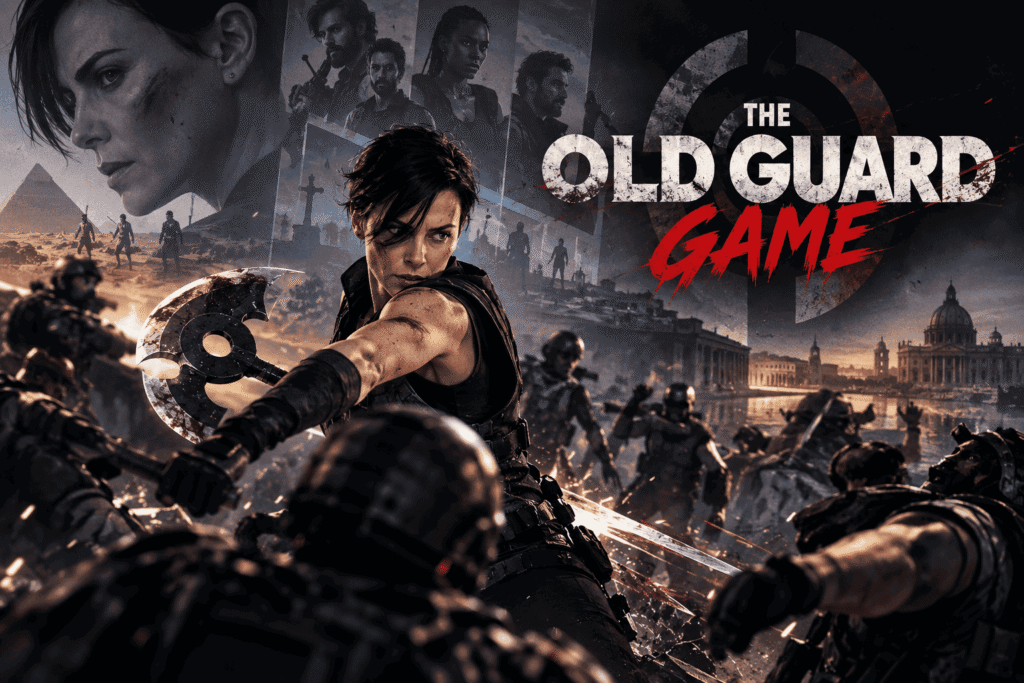
Players control Andy, the ancient warrior played by Charlize Theron in the Netflix film.
Andy enters battle carrying her Labrys, a double-bladed weapon that has become one of her
trademarks. From a top-down view, players fight waves of enemies while moving from one
target to another.
At first, the gameplay feels familiar.
Enemies arrive.
Andy attacks.
Players move around, avoid incoming attacks, and look for a chance to take down enemies
as quickly as possible.
Then Andy dies.
In most games, this is where the game over screen would appear.
But that doesn’t happen here.
Death only slows the player down.
This simple idea makes the gameplay feel different.
The developers could have ignored the logic of the movie and simply given Andy a normal
health system with a limited number of lives, just like many other action games.
Most players probably wouldn’t have questioned it.
Instead, they took a different approach.
Immortality became part of the game’s rules.
Andy can come back.
The fight can continue.
But that doesn’t mean death has no consequences.
That small difference is what makes the mechanic work.
If immortality removed every consequence, the battles would quickly lose their meaning.
Why avoid an attack if getting hit changes nothing? Why worry about enemies if they
can’t really stop you?
Because of this, the game separates two things that are often treated as the same:
dying and losing.
Andy can die without the player immediately losing the game.
But every death still has a price.
That price is time.
And once time becomes important, immortality no longer feels like an unlimited cheat.
The Real Enemy Is Time
This is where the game starts to look a little different.
On the screen, Andy’s enemies are the people attacking her.
But when it comes to gameplay, the player’s biggest enemy is actually time.
Players need to defeat as many enemies as possible while avoiding unnecessary damage.
Technically, you can play carelessly.
Run into a group of enemies.
Attack without thinking about your position.
Die.
Come back.
Then do it again.
Andy can still continue fighting.
But that doesn’t mean you’re playing well.
Every death breaks your momentum.
This creates an unusual relationship with death.
In many video games:
Death = failure.
In The Old Guard Game, it is closer to:
Death = lost efficiency.
The difference may seem small.
But it changes why players try to stay alive.
You are not keeping Andy alive because you’re afraid the entire journey will suddenly end.
You avoid dying because every mistake can waste valuable time.
Immortality still has a price.
Not another life.
Just the seconds you have lost.
Immortality Is More Interesting When There Are Consequences
Stories about characters who cannot die have their own challenge.
If the audience already knows that a character will survive,
how can a fight still feel dangerous?
Simply making that character even stronger isn’t always the answer.
If a character cannot be defeated at all, fights can become less exciting because
the audience can already guess what is going to happen.
The Old Guard handles immortality a little differently.
Its characters can survive injuries that would normally kill an ordinary person.
But coming back to life doesn’t automatically remove pain, loss, memories,
or the burden of living for hundreds of years.
They are immortal.
But living forever doesn’t mean life becomes simple.