
Still, newer technology doesn’t always mean a better experience.
Source 2 Gives Counter-Strike a Different Look
The most noticeable change in Counter-Strike 2 is the switch to Source 2.
For anyone who spent years playing CS:GO, the difference is easy to spot. Lighting looks more natural, building surfaces have more detail, and areas that once appeared dark are now easier to see.
Dust II is a good example.
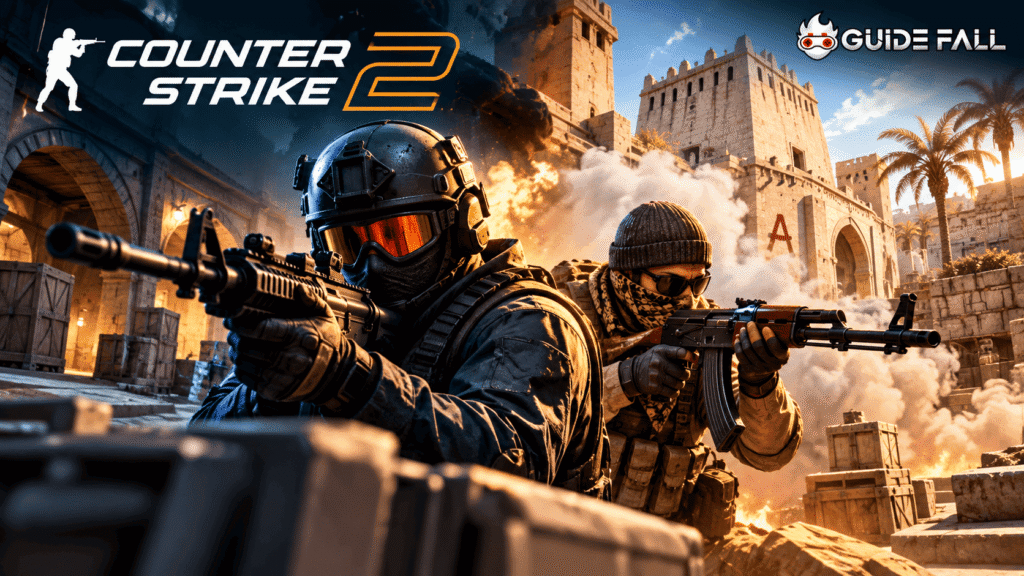
The map still has the familiar routes and locations. Players can find Long A, Mid, and B Site without having to learn everything again.
However, updated lighting and materials give the environment a cleaner appearance.
At first, this might seem like a purely visual improvement. In competitive games, though, being able to spot an opponent clearly can make a real difference.
Imagine holding a tight angle while waiting for an enemy to appear. If the character model blends into the surroundings, identifying the target might take a little longer.
Better lighting can help reduce that problem.
There’s another side to consider, however.
Modern graphics also demand more from a computer. Players using older hardware may need to lower their settings to maintain a stable frame rate.
In a competitive FPS, consistently high frame rates often matter more than realistic shadows.
As a result, improved graphics don’t necessarily benefit every player in the same way.
Smoke Grenades Are More Than Just Visual Cover
If there’s one change that genuinely affects how players approach a match, it’s the smoke grenade.
In CS:GO, smoke grenades were mainly used to block an opponent’s vision. Players would throw one at a specific location, wait for the smoke to spread, and use those few seconds to move or take position.
Counter-Strike 2 keeps that basic purpose but changes how smoke behaves.
Smoke grenades now use a volumetric system that allows the smoke to interact with the environment. It fills spaces and adjusts its shape depending on the surrounding area.
Gunfire can temporarily create openings in the smoke, while HE grenade explosions can briefly disperse it.
These changes might sound minor until you consider how they affect a match.
For example, a team might throw a smoke grenade to block an entrance to a bombsite. Normally, that smoke provides temporary cover, allowing players to move into position.
Now, opponents have ways to disrupt that cover with gunfire or explosives.
That means smoke can no longer be treated as completely reliable protection.
Attacking teams need to be more careful when moving behind smoke, while defenders have opportunities to create openings and gather information.
Still, this mechanic doesn’t automatically make the game easier.
Players need to understand when to use their utility, how opponents might respond, and whether a particular smoke actually provides the protection they need.
It creates more tactical possibilities without removing the grenade’s original purpose.
The Sub-Tick System and the Question of Accuracy
Timing has always been a major part of Counter-Strike.
Even a slight delay can cost a player a gunfight. That’s why the way servers receive and process player actions matters so much.
Counter-Strike 2 introduces a sub-tick architecture designed to record the timing of actions such as movement, shooting, and grenade throws.
In traditional tick-based systems, servers update the game state at specific intervals.
Sub-tick is designed to determine more precisely when an action occurs rather than relying entirely on those update intervals.
In theory, this allows the server to represent player actions more accurately.
However, there’s a difference between accurately recording an action and how that action feels during gameplay.
Internet connections, latency, computer performance, and the way animations appear on screen can still affect what players experience.
Someone might feel they’ve already moved behind a wall, only to get hit anyway. Situations like this don’t necessarily prove that a particular system is malfunctioning.
Understanding what happened requires more information about network conditions, action timing, and how the server processed the interaction.
That’s why sub-tick deserves a closer look.
The technology offers a different way to handle player actions, but a competitive system shouldn’t be judged by its technical explanation alone.
What matters most is that matches feel fair and consistent.
Classic Maps, Different Approaches to Updating Them
Changing a Counter-Strike map isn’t a simple task.
Every hallway, box, doorway, and corner serves a purpose. Players spend countless hours memorizing where to position their crosshair as they move through particular areas.
Even small changes to a map can affect how players attack or defend.
That’s why Valve took different approaches when bringing older maps into Counter-Strike 2.
Some maps, including Dust II, received improvements mainly focused on lighting and visual clarity without significantly changing their original layouts.
Others received more extensive updates to materials, lighting, and environmental details. Overpass, for example, underwent a more substantial visual overhaul using Source 2.
The approach makes sense.
If every map were drastically redesigned, longtime players would need to relearn many things they had already mastered.
On the other hand, keeping everything exactly as it was would make the new engine feel less meaningful.
Valve tried to find a balance between the two.
However, better-looking maps don’t necessarily produce better matches.
Good map design also depends on the balance between attackers and defenders, the number of available routes, and opportunities for rotations.
Better lighting helps players see their surroundings, but the layout still determines how a match plays out.
Aim Still Matters, but Strategy Can’t Be Ignored
One reason Counter-Strike has maintained such a strong competitive community is that its mechanics are relatively easy to understand but difficult to master.
Players need to aim their weapons and eliminate opponents. Doing that consistently, however, requires an understanding of recoil, crosshair placement, movement, and how different weapons behave.
Counter-Strike 2 doesn’t change that.
Players still need to know when to stop moving before firing if they want their shots to be accurate.
The same applies to using the AWP.
The weapon can provide a significant advantage from the right position. However, someone who spends too long watching a single angle risks getting attacked from another direction.
This is where teamwork becomes important.
A simple callout about two enemies in Mid can help teammates decide whether to hold their positions or rotate elsewhere.
It might not look impressive, but sharing that information is often more useful than trying to win every fight alone.
Then there’s the economy.
Buying expensive weapons and equipment every round isn’t always the best decision. When a team’s money is running low, saving for the next round can sometimes be the smarter choice.
Players with good aim certainly have an advantage, but they still need information, equipment, and sound decisions to make the most of their skills.
Is Counter-Strike 2 More Accessible to New Players?
Improved graphics and a more modern presentation may make Counter-Strike 2 look more appealing to newcomers.
However, learning the basics still takes time.
New players need to understand the maps, become familiar with different weapons, learn how the economy works, and figure out when to use grenades.
The problem is that most of these skills can’t be mastered simply by reading instructions.
Someone might understand that a flashbang is designed to blind opponents, but knowing exactly when to throw it is another matter.
Throwing one too early can make it useless by the time teammates enter an area. Without proper communication, a poorly timed flashbang can even blind friendly players.
Mistakes like these are part of learning the game.
Meanwhile, experienced players bring years of knowledge from CS:GO or earlier Counter-Strike titles.
They already understand rotation routes, defensive positions, and common patterns that appear during matches.
That difference in experience can make things difficult for newcomers, especially when they’re matched against opponents who know the game far better.
But difficulty isn’t necessarily a bad thing.
For some players, the most satisfying part of Counter-Strike comes from finally understanding what they were doing wrong.
Winning a duel they used to lose or successfully predicting an opponent’s strategy can feel more rewarding than simply leveling up or unlocking another item.
New Technology Doesn’t Automatically Fix Old Problems
Major updates often create expectations that problems from previous versions will finally be resolved.
Counter-Strike 2 faces those expectations as well.
Players want responsive matches, stable performance, fair competition, and effective protection against cheating.
However, not all of these problems can be solved by switching engines.
Source 2 provides a more modern technical foundation, but the overall experience still depends on several factors.
Anti-cheat systems, for example, require ongoing development and adjustments. The same applies to weapon balance, server performance, and map updates.
There’s another important factor: player trust.
In competitive matches, players need to feel that wins and losses are primarily determined by their own skills and decisions.
When an interaction feels inconsistent, players may begin questioning the game’s systems, even when the actual cause isn’t immediately clear.
That’s why introducing new features isn’t enough.
Valve also needs to maintain existing systems, address problems as they appear, and ensure future changes don’t disrupt competitive balance.
Counter-Strike relies heavily on consistency.
Major updates might attract attention, but the everyday experience is what ultimately determines whether players keep coming back.
Is Counter-Strike 2 Actually Better Than CS:GO?
There’s no simple answer to that question.
From a technical perspective, Counter-Strike 2 introduces several clear improvements.
Source 2 delivers more modern visuals. Dynamic smoke grenades create new tactical opportunities, while sub-tick offers a different approach to recording player actions.
However, technological improvements don’t necessarily make every part of the game better for everyone.
Players who care about visuals may prefer CS2’s updated environments. Those using less powerful computers, meanwhile, might be more concerned about performance and maintaining stable frame rates.
Experienced players may also need time to adjust old habits, particularly when changes to certain mechanics affect strategies they’ve relied on for years.
There’s another reason why comparing CS2 with CS:GO is complicated.
CS:GO evolved through years of updates. When Counter-Strike 2 arrived, players weren’t simply comparing it with an older game. They were comparing it with an experience they’d spent thousands of hours learning and mastering.
Meeting those expectations was never going to be easy.
Even so, Counter-Strike 2 hasn’t abandoned everything that made its predecessor popular.
Matches still revolve around map control, economic decisions, utility usage, and teamwork.
The biggest differences lie in how some of those mechanics now function.
In other words, CS2 isn’t an entirely different game. It’s an attempt to modernize Counter-Strike’s foundation while preserving its competitive identity.
Counter-Strike’s Future Depends on More Than Graphics
Counter-Strike has gone through numerous changes since its earliest days.
Technology has improved, visuals have become more detailed, and the strategies players use have grown increasingly complex.
Yet the basic principles remain largely unchanged.
Five players must work together against five opponents. Each team has limited resources, a ticking clock, and objectives to complete.
Having the better weapons doesn’t guarantee victory.
A single mistake can still turn a round around.
That’s the core strength of Counter-Strike, and it’s something CS2 continues to preserve.
Source 2 gives Valve opportunities to develop the game further, but meaningful updates don’t always need to introduce major features.
Sometimes, performance improvements, map adjustments, or more consistent gameplay matter far more to competitive players.
Conclusion
Counter-Strike 2 shows that modernizing a legendary FPS involves more than improving its graphics.
Source 2, dynamic smoke grenades, and sub-tick introduce important changes, but their value ultimately depends on how they affect actual matches.
CS2 offers several improvements over CS:GO, particularly in its technology and environmental interactions. However, performance, consistency, competitive balance, and the overall player experience remain just as important.
In the end, players might not keep returning to Counter-Strike because of its graphics or the technology running behind the scenes.
There’s something satisfying about watching a strategy work, seeing a teammate rescue a round that seemed lost, or realizing that one simple decision made the difference between winning and losing.
Counter-Strike 2 changes how the game looks and how some of its systems work, but much of its appeal still comes from something players have understood for years.
Every round is another chance to make a better decision than the last.