
100 Players, Three Teams, and One Battlefield
One of the biggest differences between WARDOGS and many other military shooters is how its teams are organized.
Most FPS games pit two teams against each other. WARDOGS takes a different approach, allowing up to 100 players to compete across three teams in a single match.
It sounds like a small change, but it could have a major impact on strategy.
In a traditional two-team battle, players can usually make a reasonable guess about where enemy attacks might come from. Things become less predictable when three groups are fighting over the same objectives.
One team might launch an attack against an enemy position, only for the third team to move in and capture the territory left behind.
Winning a firefight doesn’t necessarily mean gaining an advantage in the overall battle.
Players need to watch both opposing teams while protecting the territory they’ve already captured.
WARDOGS uses a Control Zone system, where teams compete to secure a designated area. The first team to earn 100 points wins the match.
This encourages players to focus on the objective rather than simply roaming the map looking for enemies.
Still, having three teams creates opportunities for unexpected outcomes. Two groups could spend valuable resources fighting each other while the third takes advantage of the situation and secures a better position.
Knowing when to attack, defend, or stay out of a fight could be just as important as having good aim.
Freedom Doesn’t Mean Everyone Has to Fight on the Front Line
There’s a familiar routine in FPS games: spot an enemy, aim, and try to get as many eliminations as possible.
WARDOGS offers more options.
Players who struggle with close-range combat can still contribute in other ways.
Someone might prefer using a sniper rifle to watch enemy movements from higher ground. Another player could drive a vehicle and transport teammates to the battlefield.
Others may spend their time building defenses.
Each role has a purpose, but its usefulness depends on what’s happening during the match.
A sniper needs to find the right position to support the team. Likewise, a driver who spends the entire match driving around without delivering help isn’t accomplishing much.
Whatever role players choose, their actions should contribute to the team’s objectives.
This is an important part of keeping WARDOGS engaging.
Giving players plenty of options is appealing, but the real challenge is making sure those options serve a purpose rather than becoming activities that feel unnecessary.
Military Vehicles Offer Different Ways to Control the Battlefield
If an enemy position is nearby, reaching it on foot might be simple enough.
In a large-scale battle, however, vehicles can change how players approach an objective.
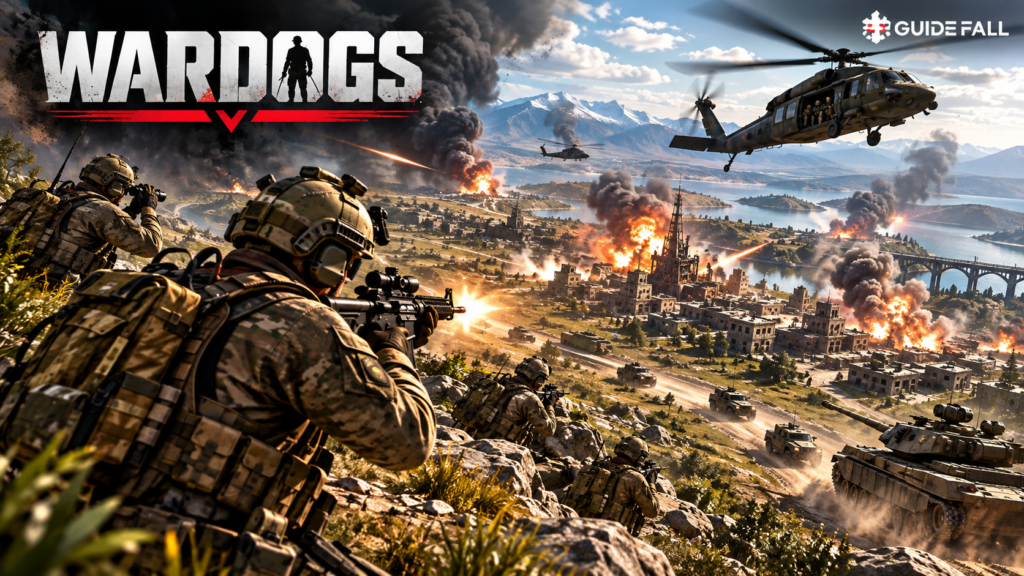
WARDOGS features various military vehicles designed to support team operations.
Ground vehicles can transport troops or provide fire support, while helicopters allow players to travel through the air.
This means combat isn’t limited to soldiers exchanging gunfire.
One group might attack directly from the ground while another uses vehicles to approach the same objective from a different direction.
But powerful vehicles don’t guarantee victory.
An overconfident driver could lead teammates straight into a dangerous position. Using vehicles carelessly could also waste resources that might be needed elsewhere.
Vehicles shouldn’t be treated simply as faster transportation or a way to deal more damage.
Players need to think about when a vehicle is necessary, which route is safer, and how it can help the team reach its objective.
Building defenses is another option for protecting captured territory.
Building Defenses Can Be Just as Important as Attacking
In many shooters, buildings are simply part of the environment.
Players hide behind walls, enter rooms to avoid enemy fire, or look for elevated positions to get a better view of the battlefield.
WARDOGS adds another layer through its defensive construction system.
Spending too much time building, however, can hurt the team when more players are needed on the front line.
The system allows players to prepare positions before enemy attacks begin.
For example, after capturing a Control Zone, some teammates might guard the entrances while others build additional cover.
This could make the area more difficult for enemies to capture.
Still, building as many defenses as possible isn’t always the smartest move.
Structures placed in the wrong locations may offer little protection.
Players should build what they actually need rather than constructing something simply because the game allows it.
Attackers can also use heavy weapons to destroy enemy defenses.
These decisions are part of the tactical experience WARDOGS aims to deliver.
Players need to assess their surroundings before deciding whether to hold their position, reinforce it, or move toward a new objective.
Destructible Environments Change How Battles Play Out
Cover doesn’t always remain safe throughout a match.
In WARDOGS, buildings and other environmental structures can take damage from player attacks. Rockets can destroy buildings, while armored vehicles can clear paths through urban areas.
Destructible environments introduce another tactical consideration.
Imagine a group of players defending a building overlooking the Control Zone.
In a traditional FPS, attackers might need to enter through a doorway or find another route around the building.
Destruction offers another possibility.
Heavy weapons can damage the cover protecting enemy soldiers.
Meanwhile, defenders must recognize that a position that seems secure at first might not remain safe for long.
As interesting as this sounds, destruction also raises questions about balance.
Could heavy vehicles make defensive structures too easy to destroy? And if that’s the case, would building defenses still be worthwhile?
The answers depend on how these mechanics perform during actual matches.
Environmental destruction becomes more meaningful when players must consider the risks and costs involved, rather than simply destroying everything because they have powerful weapons.
Money Plays a Major Role in Every Decision
WARDOGS also features an economy that influences the choices players make during combat.
Each player starts with $10,000.
That money can be spent on weapons, supporting equipment, and military vehicles.
More importantly, players can carry their money from one match into the next.
This makes resource management an important part of the experience.
A player might purchase expensive equipment to gain an advantage in combat.
But that decision comes with risks if the equipment isn’t used effectively.
Someone who chooses a more affordable loadout, on the other hand, could save money for future battles.
WARDOGS also rewards players for activities that support their team.
Reviving teammates, transporting soldiers to combat zones, and helping capture territory are among the actions that can earn money.
The system encourages players to help each other.
However, an economy like this needs careful balancing.
If wealthy players consistently gain too much of an advantage, newcomers or players who have lost valuable resources could struggle to compete.
The success of WARDOGS’ economy therefore depends on more than the number of items available for purchase.
It also depends on whether players have fair opportunities to earn money and make effective use of their resources.
A Bigger Map Doesn’t Always Mean Better Battles
WARDOGS features a map covering 256 square kilometers.
That provides plenty of room for vehicle movement, reconnaissance, and attacks from different directions.
But a large map can also create problems for an FPS.
The greater the distance between locations, the longer players may need to travel before reaching the action.
If those journeys take too long without anything interesting happening, the experience could become frustrating.
WARDOGS attempts to address this with a randomly positioned Control Zone measuring 2 × 2 kilometers.
All three teams fight to control this area.
The approach keeps the main battle focused on a particular location while leaving surrounding territory available for tactical movement.
Players can use the additional space to find alternative routes, position vehicles, or approach enemies from unexpected directions.
But map size alone doesn’t determine whether a game is enjoyable.
Objective placement, transportation options, and the time required to return to combat also matter.
A large map is most valuable when it creates interesting choices rather than simply making players travel farther.
Communication Can Be a Weapon of Its Own
Having powerful vehicles, weapons, and equipment doesn’t guarantee a team will win.
Sometimes the real problem is that players move without understanding what their teammates are planning.
WARDOGS includes local voice chat, allowing players to communicate with others nearby.
Even a short warning can make a difference during combat.
A player might notice an enemy vehicle approaching a defensive position. By warning nearby teammates, the group has time to prepare before the attack begins.
The same applies when someone needs help holding a position.
However, too much communication can become distracting.
Unclear information, unrelated conversations, and disruptive behavior can make teamwork less effective.
Good communication isn’t about talking constantly.
It’s about sharing useful information clearly and at the right moment.
Is WARDOGS Worth Playing Solo?
Some players prefer entering matches alone, gathering equipment, and deciding what to do based on the situation.
WARDOGS is designed to accommodate both team-oriented and more independent approaches.
Players can join a squad or operate on their own while still contributing to the team.
For example, a solo player might choose to work as a sniper, watching enemy movements from a distance.
They could also deliver supplies using vehicles or help reinforce defensive positions.
That freedom doesn’t necessarily mean solo players will find every task easy.
Certain activities are likely to work better with coordinated teammates, particularly when dealing with major attacks or defending an area targeted by two opposing teams.
What matters is whether WARDOGS gives independent players meaningful opportunities to contribute.
If solo players can perform useful tasks without having to follow every instruction from a squad, the game could appeal to a wider range of players.
What Makes WARDOGS Different From Other FPS Games?
Large-scale military shooters aren’t a new concept.
Other games have already introduced heavy vehicles, expansive maps, and territory-control systems to create more complex battles.
WARDOGS therefore needs more than a large player count or an enormous map to stand out.
Its more interesting qualities come from how the different systems work together.
Players can earn money by helping teammates, spend that money on equipment, and choose activities based on what their team needs.
Meanwhile, construction and destruction mechanics allow the battlefield to change through player actions.
Three-team warfare adds another level of uncertainty, as every group must deal with two opposing forces pursuing their own objectives.
These features sound promising, but adding more mechanics doesn’t automatically make a game better.
An overly complicated system can make it difficult for players to understand what they should be doing.
WARDOGS needs to give every activity a clear purpose.
Players who build defenses should feel that their work matters. Vehicle drivers should have good reasons to transport and support teammates rather than simply driving around the map.
Ultimately, the game’s freedom will matter most if all these different roles contribute to a battle that feels rewarding and worth fighting.