
or buying new vehicles. Players need to manage a transport network that continues
to change as cities grow, passenger numbers increase, and industries demand more.
From dealing with traffic to finding more efficient routes, every decision can
affect how the network develops.
Transport Fever 3 – Build a Transport Network and Grow Your City
Building a railway from one city to another may sound simple.
Lay the tracks, buy a train, choose the stations, and wait for passengers to arrive.
But in Transport Fever 3, things do not stop there.
A route that looks good may not always make money. A busy station does not
necessarily mean that the network is working well either. As the city gets
busier, new problems begin to appear. Roads that were once clear can become
crowded as more vehicles start using them.
The game is not only about building transportation. Players also need to think
about what happens after the network starts running.
From Small Roads to a Large Transport Network
At the beginning of the game, the network may still be fairly simple.
A few vehicles and basic routes can be enough to connect important places.
But the world does not stop growing just because a route is finished.
Cities can grow larger.
Passenger numbers can increase.
Industries need deliveries.
And roads that once seemed large enough can slowly become crowded with traffic.
Transport Fever 3 is designed around cities and their needs
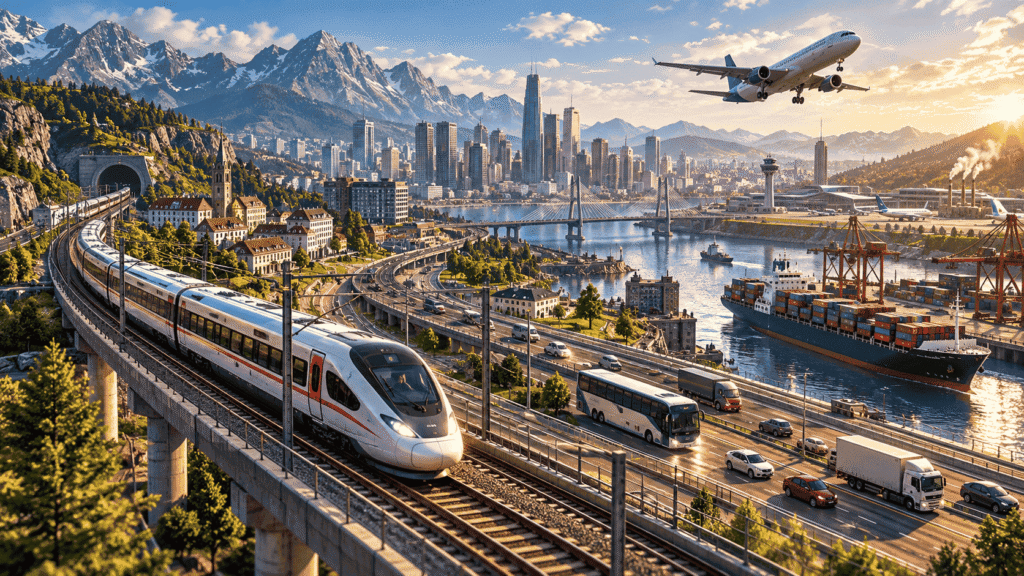
continuing to develop. Players can connect cities and industries by road,
rail, sea, and air.
That freedom also raises an important question:
Does every transport problem need to be solved by building more routes?
Not necessarily.
Sometimes the real problem is not a lack of roads, but an inefficient route.
A station may be in the wrong place. Trains may not arrive often enough.
Intersections can slow down traffic, or too many services may be using the
same route.
In other words, building more is not always the best answer.
Sometimes improving what is already there is more important.
A Growing City Can Bring New Problems
There is something satisfying about watching a small city slowly grow into
a larger and busier place.
But that growth comes with consequences.
More residents mean more people traveling to work, going shopping, or
visiting other cities.
Transport Fever 3 simulates residents with homes, jobs,
and places they want to visit. City development is also affected by passenger
transportation, goods supply, traffic, travel times, noise, pollution,
and resident satisfaction.
Because of this, growth does not always make the player’s job easier.
Sometimes it does the opposite.
A successful city can create bigger and more complicated problems.
Imagine a main road that was originally used by only a few buses and cars.
As the city grows, more vehicles start using it. Buses that once arrived
on time may get stuck in traffic. Passengers have to wait longer, and the
whole route becomes less efficient.
Players then have several options.
Widening the road might help.
Creating dedicated lanes for public transport could also work.
Or perhaps trains and trams could reduce the number of vehicles using the road.
There is not always one correct answer.
That is where the strategy begins.
The Fastest Train Is Not Always the Best Choice
There is a simple temptation when playing a transport game:
If a faster vehicle becomes available, use it.
But speed does not always mean efficiency.
Every vehicle has a cost. Infrastructure requires investment, while fleets
need to be managed and maintained.
A high-speed train may be useful for connecting large cities with many passengers.
But do we really need an expensive train for a short journey?
The same idea applies to cargo.
Using an airplane may look like the fastest way to move goods from one place
to another. However, not every type of cargo needs to arrive as quickly as possible.
Sometimes a much slower ship may actually make more sense.
Transport Fever 3 becomes more interesting when players
stop asking:
“Which vehicle is the fastest?”
and start asking:
“Which vehicle is best for this route?”
The two questions sound similar, but they can lead to very different decisions.
Goods Do Not Move by Themselves
Passengers are only one part of the network.
Industries also need transportation.
Goods need to move from one location to another, and the larger the network
becomes, the more complicated the logistics chain can get.
Transport Fever 3 features more than 35 types of industries,
including offshore industries. Its cargo system also gives players control
over loading and unloading, with warehouses and dedicated terminals available
to help manage distribution.
This makes logistics a challenge of its own.
Imagine goods arriving by ship.
After reaching the port, they are transferred to a train.
The train then carries them to a terminal near the city before trucks complete
the final part of the journey.
A single delivery can involve several types of transportation.
The problem is that a delay in one part of the network can affect everything else.
A train that arrives too early may have to wait for cargo.
Too few trucks can cause a terminal to fill up.
A port built too far away can also increase costs.
A good transport network is not simply one that moves quickly.
Every part of it needs to work together.
Roads Need Strategy Too
Transport Fever 3 gives players more control over road construction.
Lanes can be merged or separated, connections between lanes can be managed,
and players can create dedicated lanes for specific purposes.
At first, these may sound like small details.
But anyone who has watched a virtual city become trapped in traffic knows
that one bad intersection can create a much bigger problem.
Interestingly, traffic can also provide useful information.
If vehicles continue to pile up in the same place, the game is indirectly
telling the player that something is wrong.
Maybe the road is too small.
Maybe the traffic lights are not working effectively.
Or perhaps too many vehicles are being directed toward the same location.
In this way, traffic is more than just an annoyance.
It becomes a problem that players need to understand and solve.
Do Not Focus Only on Profit
As a tycoon game, making money is obviously important.
Every delivery can generate income, while vehicles and infrastructure come
with their own costs.
But Transport Fever 3 seems to make success more complicated
than simply watching the company’s balance grow.
Noise can affect certain areas.
Pollution needs to be considered.
Travel times can influence satisfaction.
Traffic can slow down development.
This creates some interesting decisions.
For example, placing a large station in the middle of a city may make it
easier for passengers to reach.
But the station and the traffic around it can also create noise.
Moving it to the edge of the city may reduce that problem, but then players
need to figure out how passengers will reach the station.
One solution can create another problem.
That is what can make a management game feel alive.
Players are not simply searching for the correct answer.
They are looking for the best compromise.
The World Changes, and Plans Need to Change Too
In a strategy game, situations can change at any time.
Transport Fever 3 builds around this idea.
Transportation in the game develops across more than a century, beginning
around 1900 and continuing through 2030 and beyond. Technology changes,
new vehicles become available, cities grow, and the needs of the network
change with them.
A railway that works perfectly in one period may no longer be ideal several
decades later.
A small station may need to be expanded.
Old roads may need to be changed.
Vehicle fleets may need to be replaced.
A route that once made a lot of money might even lose its importance as
other parts of the network develop.
This means players are not only builders.
They also need to be willing to look at their own network and say:
“This worked well before, but now it is time to change it.”
In building games, changing or removing something we have already created
can sometimes feel harder than building it in the first place.
But adapting to change can become an important part of the game.
Not Every Player Has to Be the Same Kind of Tycoon
Another interesting part of Transport Fever 3 is that it
does not force everyone to play in exactly the same way.
Players who enjoy economic challenges can use Tycoon Mode
and adjust the difficulty.
Those who prefer building freely can choose Sandbox Mode
and even remove costs so they do not have to worry as much about money.
There is also a campaign with missions inspired by historical events.
This approach makes sense.
Not everyone plays a transport game for the same reason.
Some players want to build the most profitable company.
Some enjoy solving traffic problems.
Others simply want to create a huge railway network.
And some players may spend hours just trying to make their cities look
neat and organized.
Giving players room to enjoy the game in different ways can be more
interesting than forcing everyone to follow the same definition of “winning.”
In the End, Transportation Is About Connections
Transport Fever 3 is filled with trains, buses, trucks,
ships, airplanes, helicopters, roads, railways, ports, and airports.
But when you look beyond all those vehicles and buildings, they share
one basic purpose:
Connecting things.
Connecting homes with workplaces.
Connecting small towns with large cities.
Connecting industries with markets.
Connecting ports with terminals.
And when one of those connections stops working properly, the effects
can spread throughout the rest of the network.
That may be one of the most interesting parts of Transport Fever 3.
At first, players may simply want to build one railway line connecting
two places.
A few hours later, that small route may have grown into a huge network
filled with stations, highways, ports, airports, warehouses, and different
vehicles that all depend on one another.
At that point, the biggest question is no longer:
“What should I build next?”
Instead, it becomes:
“How do I keep everything running smoothly?”
And perhaps that second question is exactly what makes a transport game
so difficult to put down.