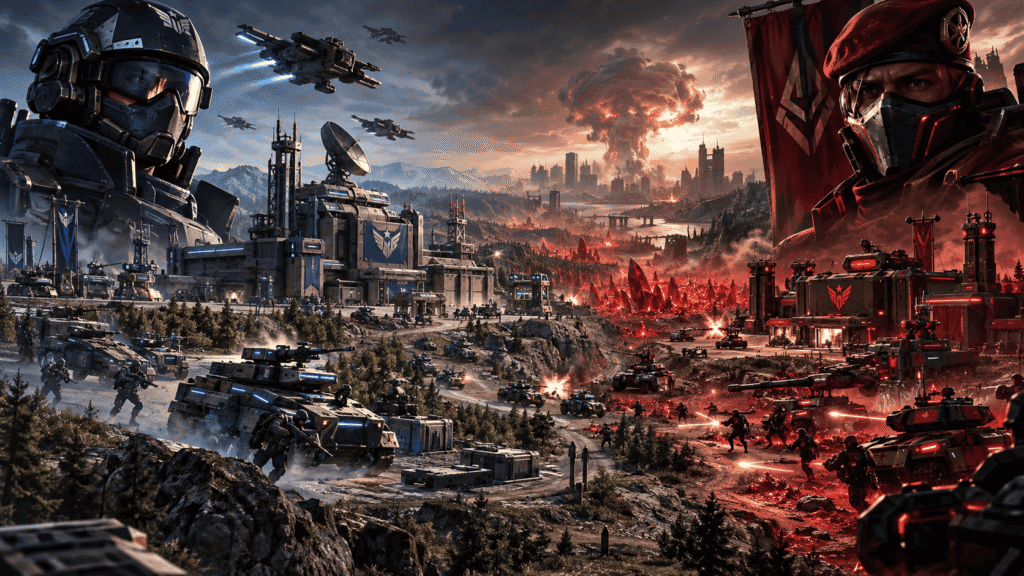

Players can build bases, gather resources, create armies, and plan their moves
while fighting against enemies. Set in an alternate version of 1997 after a
nuclear war changed civilization, the appearance of a mysterious plant called
Tempest creates a valuable new resource and becomes one of the reasons different
powers are fighting for control.There is something satisfying about watching a small base slowly grow into a
military force capable of controlling the battlefield. At first, there may only
be a few buildings, a small number of units, and large parts of the map that
have yet to be explored. A few minutes later, everything can look completely
different.Tempest Rising builds much of its gameplay around this kind
of progression.The game takes plenty of inspiration from real-time strategy games of the 1990s
and 2000s. Players build bases, collect resources, produce units, expand their
territory, and try to understand what the enemy is doing before launching an
attack. The idea may sound familiar, but that classic approach is an important
part of Tempest Rising‘s identity.
A World Changed by War
Tempest Rising does not follow history as we know it.
The story takes place in an alternate version of 1997. In this world, the Cuban
Missile Crisis grew into a much larger conflict that eventually led to World
War III and the use of nuclear weapons.
The war may be over, but the world it left behind has changed.
In areas damaged by the conflict, a mysterious plant known as Tempest begins
to appear. The plant has unusual electrical properties and eventually becomes
a highly valuable resource. Its existence creates new possibilities for
humanity while also raising questions about where Tempest actually came from.
This is where the conflict becomes more interesting.
Tempest is not simply another material that players collect to produce their
next unit. It is also one of the reasons different powers are fighting against
each other.
Two Powers with Different Ways of Fighting
The Global Defense Force (GDF) is one of the groups involved
in the conflict. It emerged after World War III came to an end.
The GDF relies on technology, intelligence gathering, mobility, and more precise
attacks. Some of its mechanics even allow units to collect intelligence from
marked enemies and use that information to support future operations.
On the other side is the Tempest Dynasty.
This group was formed from several nations across Eurasia that were heavily
affected by the war. They see Tempest differently. For the Dynasty, this resource
is closely connected to their territory and their future after the destruction
caused by the war.
The differences between these groups are not limited to the story.
They also build their forces and use their units differently. Because of this,
choosing a faction is not simply about deciding which units look better. It also
changes how players deal with problems on the battlefield.
Building a Base Is Only the Beginning
In an RTS game, having the largest army does not always mean you are in the
best position.
Resources need to keep coming in. New units need to be produced. Territory has
to be protected, and players also need to pay attention to what the enemy is doing.
Focusing too much on the economy can give the enemy a chance to attack first.
On the other hand, producing too many units early in the game can quickly drain
resources before those units provide any real advantage.
Situations like these are what make strategy games interesting.
A small decision can sometimes create a problem that only becomes noticeable
several minutes later.
A base that looks safe may not actually be fully protected. Focusing too much
on one route can also be risky. The enemy might simply attack from another direction.
Because of this, battles are not only about who has the biggest weapons. Players
also need to know when to attack, when to improve their economy, and when it is
better to hold their position.
A Campaign That Leaves Room to Experiment
Tempest Rising features two story-driven campaigns that put
players in the role of a Commander. During these campaigns, players can adjust
their forces depending on what each mission requires. The game also features
three unique factions with different approaches to combat and their economies.
Every battle can play out differently, so players do not always have to rely
on the same strategy.
Different missions may also require different units. Players need to adjust
their armies depending on the situation. The terrain, enemy forces, available
resources, and mission objectives can all be reasons to change the original plan.
And this may be where Tempest Rising feels closest to classic
RTS games.
It is not simply because the game tries to recreate the past. Instead, players
are constantly faced with a simple question that can have many different answers:
with the resources and units available right now, what should I do next?
The answer can change at any moment.
A successful attack can open a path toward the enemy base. At the same time,
one mistake in protecting important resources can stop production just when
new units are needed the most.
In the end, Tempest Rising brings back one of the ideas that
has made RTS games enjoyable for so long: starting with almost nothing, building
a strong base, protecting it when things begin to go wrong, and trying to turn
each small decision into an advantage on the battlefield.