
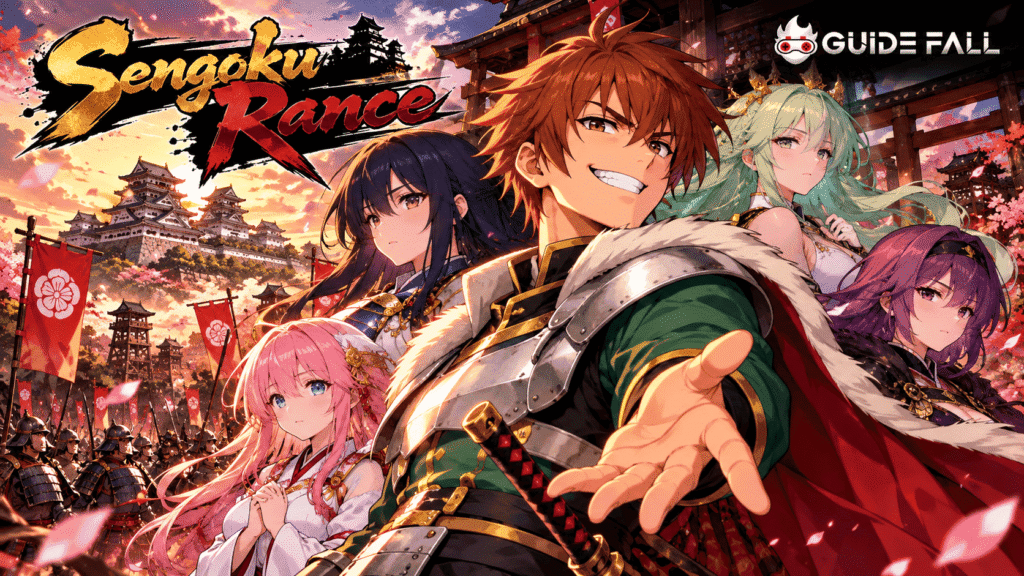

What makes Sengoku Rance interesting isn’t just winning battles. It’s dealing with the consequences of every decision along the way.
Rance’s Journey with the Oda Clan
Rance isn’t your typical heroic protagonist.
He’s a selfish adventurer who often does whatever he wants, putting his own desires ahead of everyone else’s. Unlike traditional heroes who fight to save the world or protect innocent people, Rance is usually more concerned with himself.
In Sengoku Rance, he becomes involved with the Oda clan as it struggles for power against rival factions.
The Oda clan plays a central role throughout the game. Starting with limited territory, players can gradually expand its influence through military campaigns and political decisions.
However, gaining more land doesn’t always mean immediate progress.
Every new territory brings additional responsibilities. Players must strengthen defenses, organize troops, and watch for threats from clans that remain undefeated.
Things become even more difficult when facing opponents with larger or stronger armies.
It’s a reminder that winning a war takes more than simply attacking everything in sight.
A Strategy System That’s Easy to Understand
One of Sengoku Rance’s greatest strengths is how it introduces its strategy mechanics.
Instead of overwhelming players with complicated kingdom management systems, the game focuses on a series of actions available during each turn.
Players can attack enemy territories, recruit new characters, improve their armies, or perform other activities that support the clan’s growth.
The basic idea is straightforward, but there’s a catch: the number of actions available each turn is limited.
That means players can’t solve every problem at once.
For example, one territory might need additional troops to defend against an incoming attack. At the same time, a neighboring enemy region might be vulnerable, offering an opportunity to expand.
Choosing to defend could mean missing a chance to attack. On the other hand, expanding too aggressively might leave existing territories exposed.
These situations make the strategy more engaging.
Rather than always choosing the action with the biggest immediate reward, players must decide what matters most at that moment.
Preparing Your Army for Battle
Having more soldiers certainly helps, but numbers alone won’t guarantee victory.
Sengoku Rance features a combat system built around different unit types, each with its own abilities and strengths.
Some units are better suited for fighting on the front lines, while others specialize in ranged attacks or supporting teammates.
Understanding these roles is important when building an effective army.
Units with high offensive power might defeat enemies quickly, but without enough protection, they can also suffer heavy losses before the battle ends.
That’s why army composition matters.
Players must also consider the strengths and weaknesses of their opponents.
Different enemies require different tactics, so players need to adjust their approach rather than relying on the same strategy every time.
This encourages experimentation with different character combinations.
Ultimately, victory depends not only on how powerful an army is, but also on how effectively its units are used.
Recruiting Characters and Strengthening the Clan
Expanding the Oda clan involves more than capturing territory.
Players can also recruit new characters through various activities, including bringing former enemies into their ranks after meeting certain requirements.
Each character has unique abilities and serves a different purpose.
Some perform better on the battlefield, while others are more useful for activities outside combat.
However, not every character needs the same attention.
Players must decide which characters are worth improving.
Focusing on a few powerful characters can make difficult battles easier. Meanwhile, having a larger group of capable units becomes useful when fighting across multiple territories.
These choices make character management an important part of the experience.
Characters aren’t simply extra soldiers. They’re valuable resources that influence how well the clan handles future conflicts.
Controlling More Territory Doesn’t Always Make You Stronger
Expanding the Oda clan’s influence is one of the game’s main objectives.
Every captured region creates new opportunities. However, controlling more land also means having more responsibilities.
Players must deal with rival clans that have different military strengths, characters, and territorial advantages.
Attacking a seemingly weak opponent might be a smart move, but it’s important to consider what’s happening elsewhere.
Waiting too long also comes with risks.
Enemy clans won’t simply sit around while players prepare their next move. They can launch attacks while the Oda army is busy elsewhere.
This is where Sengoku Rance shows the depth of its strategy system.
Winning individual battles isn’t enough. Players also need to think about what comes next.
An attack might succeed, but it can still turn out to be a poor decision if the remaining troops aren’t strong enough to handle another threat.
A Story That Doesn’t Always Follow the Same Path
Beyond its battles and territorial management, Sengoku Rance also places considerable emphasis on storytelling.
Character relationships, clan rivalries, and major events help bring its fictional world to life.
The story doesn’t follow just one fixed path.
The game features multiple routes that introduce different story developments, giving players a reason to experience the campaign more than once.
Those who have already mastered the combat system may want to start another playthrough to discover events they missed the first time.
However, having multiple story routes doesn’t mean every small decision leads to a completely different ending.
Certain events and developments still depend on meeting specific conditions.
It’s also worth mentioning that Sengoku Rance contains adult humor, sexual themes, and explicit content that won’t appeal to everyone.
These elements are part of the wider Rance series, so they’re worth considering before playing.
Is Sengoku Rance Difficult to Play?
At first, Sengoku Rance is relatively easy to understand.
The action menus are straightforward, and the objective of expanding your territory gives new players a clear sense of direction.
However, the difficulty increases as more enemies enter the conflict.
Players must carefully manage their available actions, choose suitable characters, and keep their armies strong enough for upcoming battles.
Small mistakes don’t always lead to immediate defeat.
Sometimes, the consequences only become clear several turns later, when troops are running low or there aren’t enough actions available to repair weakened defenses.
This makes the experience different from strategy games that focus almost entirely on combat.
Knowing how to attack is only part of the challenge. Players also need to recognize when it’s better to stop, regroup, and prepare for the next move.
Fortunately, the game doesn’t require players to learn too many complicated mechanics at once.
The challenge comes from how individual decisions affect the overall situation.
That’s what makes Sengoku Rance easy to learn but difficult to master.
The Strengths and Weaknesses of Sengoku Rance
One of Sengoku Rance’s biggest strengths is how well it combines territorial management with tactical combat.
Every action serves a clear purpose. Players can track their progress through captured regions, recruited characters, and defeated enemies.
The turn-based structure also gives players time to consider their decisions without the pressure of reacting instantly, as they would in a real-time strategy game.
Still, the game isn’t without its weaknesses.
Some activities can become repetitive, particularly when players must fight multiple battles to capture new territories.
Those who prefer complete freedom when building and managing a kingdom may also find the available management options somewhat limited.
The story itself has a very distinctive tone.
Its crude humor, Rance’s questionable behavior, and explicit sexual content may make some players uncomfortable.
As a result, even an enjoyable strategy system doesn’t necessarily make the game suitable for everyone.
Whether someone enjoys Sengoku Rance largely depends on how well they connect with its combination of tactical gameplay and the unusual storytelling style of the Rance series.
Why Sengoku Rance Is Still Worth Playing
Plenty of strategy games feature large-scale battles, resource management, and opportunities to build powerful empires.
However, not all of them manage to make simple decisions feel important.
Sengoku Rance creates its challenge by forcing players to prioritize their actions.
There’s always a choice between strengthening the current position and taking risks for potential rewards later.
The game also offers a satisfying sense of progression.
A small territory can gradually grow into a powerful force capable of challenging major clans.
Seeing that progress unfold can be rewarding, especially when a strategy planned several turns earlier finally pays off.
Although its visuals reflect the game’s age, its mechanics still offer plenty of appeal for fans of turn-based strategy games.
Conclusion
Sengoku Rance is more than a game about attacking enemies and conquering Japan.
Behind its relatively simple systems are decisions that require careful planning. Players must choose which territories to attack, develop their characters, and keep their armies prepared for whatever comes next.
Its multiple story routes add variety, although the mature themes and controversial protagonist won’t appeal to every audience.
The game’s greatest strength lies in how its decisions connect.
Winning a battle matters, but that victory means little if players can’t defend what they’ve gained.
For fans of turn-based strategy games who enjoy territorial management, character recruitment, and tactical challenges, Sengoku Rance offers a surprisingly deep experience without making every mechanic unnecessarily complicated.